Sample
Read 12 sections, free
Complete sections, exactly as they arrive in your Word file. The other 67 of its 79 are listed below and unlock when you buy.
Cover, Licence & Disclaimer
© 2026 MolarOps Inc.
All Rights Reserved.
LICENSE & PERMITTED USE
This Manual is licensed for use by a single dental practice (the “Licensed Clinic”). The Licensed Clinic may reproduce, distribute, and modify this Manual internally for its own staff, training, audits, and regulatory compliance purposes. Resale, redistribution, sub-licensing, posting on public websites, or use by additional clinics or corporate dental groups requires a separate license from MolarOps Inc.
IMPORTANT DISCLAIMER
This Manual has been prepared as a comprehensive infection prevention and control resource for Ontario dental clinics, cross-referenced to standards and legislation as of the publication date shown on the cover. It is intended as a working template and educational resource ONLY. It does NOT constitute legal, medical, regulatory, or professional advice and does NOT create any solicitor–client, clinical, or advisory relationship between MolarOps Inc. and the Licensed Clinic or its personnel, patients, or contractors.
Regulatory standards, professional guidelines, and legislation referenced in this Manual change from time to time. Before adopting any policy, procedure, form, or checklist set out in this Manual, the Licensed Clinic MUST: (a) verify that each cited statute, regulation, standard, and guideline remains current at the time of adoption (e.g., by checking Ontario e-Laws, Justice Laws, RCDSO, CDHO, PHO, PIDAC, CSA, and Health Canada publications); (b) tailor every policy, procedure, form, and checklist to the Clinic’s specific facility, equipment, procedure mix, staff complement, and patient population; (c) maintain compliance with the Royal College of Dental Surgeons of Ontario (RCDSO), the Ministry of Health, Public Health Ontario, the College of Dental Hygienists of Ontario (CDHO), Public Health Units, federal regulators, and any other applicable authorities; and (d) seek independent legal, clinical, and professional advice where appropriate.
Items tagged “BEST PRACTICE” reflect professional consensus and are not statutory obligations in every case.
LIMITATION OF LIABILITY
To the maximum extent permitted by law, MolarOps Inc., its directors, officers, employees, contractors, and contributors shall NOT be liable to the Licensed Clinic, its personnel, its patients, or any third party for any direct, indirect, incidental, consequential, special, exemplary, regulatory, disciplinary, or punitive loss or damage (including, without limitation, loss of revenue, professional discipline, regulatory penalties, loss of licensure, or harm to patients) arising out of or in connection with the use of, reliance on, or inability to use this Manual, even if MolarOps Inc. has been advised of the possibility of such loss. The Licensed Clinic’s sole and exclusive remedy for any claim relating to this Manual is replacement of the Manual or a refund of the purchase price, at the option of MolarOps Inc. The Licensed Clinic assumes full and exclusive responsibility for all clinical decisions, professional conduct, and regulatory compliance within its practice. Nothing in this disclaimer is intended to exclude any liability that cannot, by law, be excluded.
Document Control & Approval
Document Identification
| Document Title | Infection Prevention and Control Manual |
|---|---|
| Edition | Ontario Edition 2026 |
| Publisher Edition | on.2026.7 |
| Clinic Manual Version | __________________________ |
| Owning Clinic | [Practice Name] |
| Document Owner | Designated IPAC Lead / Coordinator |
| Approving Authority | Principal Dentist |
| Effective Date | [Effective Date] |
| Next Mandatory Review | [Review Date] (within 12 months of effective date) |
| Distribution | All clinical, administrative, sterilization, and contracted cleaning staff |
| Manual Location | [Manual Location] |
Version History
| Version | Date | Author / Reviewer | Summary of Changes |
|---|---|---|---|
| v1.0 | 1 August 2026 | MolarOps | Initial publication. |
Approval & Adoption
By signing below, the undersigned confirms that this Manual has been reviewed, adopted, and is the operative IPAC policy of the clinic. The Principal Dentist holds ultimate accountability for the IPAC program in accordance with the RCDSO Standard of Practice: Infection Prevention and Control in the Dental Office.
Principal Dentist
| Print Name | Signature | Date |
|---|---|---|
Designated IPAC Lead / Coordinator
| Print Name | Signature | Date |
|---|---|---|
PHIPA Contact Person
| Print Name | Signature | Date |
|---|---|---|
Health & Safety Representative (OHSA)
| Print Name | Signature | Date |
|---|---|---|
How to Use This Manual
Manual Structure
Use the ten Parts for policies and procedures, and the appendices for forms and checklists. Appendix A is the master index. Chapter, section and form codes remain stable across editions. Appendix letters C-H are intentionally unused.
| Part | Theme | When to Reference |
|---|---|---|
| I | Governance & Foundation | On adoption, at every annual review, and during regulatory inspections. |
| II | Foundational IPAC Principles | Onboarding all new staff; annual refresher. |
| III | Staff Safety & Health | Daily clinical practice; immediately after any exposure incident. |
| IV | Sterilization & Reprocessing | Every clinical day; after any sterilizer maintenance, repair, or BI failure. |
| V | Environmental & Equipment IPAC | Daily setup, changeover and closing; waterline maintenance and any testing required by MIFU, public-health direction or the Clinic’s adopted protocol. |
| VI | Aerosols, Respiratory & Outbreak Management | During seasonal respiratory illness, declared outbreaks, or any AGMP. |
| VII | Waste & Environmental Compliance | Every shift; biomedical waste pickup days; amalgam separator service. |
| VIII | Occupational Health & Safety (OHSA) | New hire orientation; annual refresher; after any workplace incident. |
| IX | Medical Emergencies | Monthly emergency-kit checks; after any medical event in office. |
| X | Miscellaneous IPAC Policies | Onboarding; whenever a new policy violation is observed. |
Authority and action labels
Follow applicable legislation, professional standards, public-health requirements and manufacturer instructions. Clinic policies add the controls adopted by the practice. Labels identify key requirements; they do not determine legal obligations or make unlabelled instructions optional.
| Label | How to use it |
|---|---|
| MANDATORY | Follow the stated requirement and its conditions. Check the cited authority; some requirements are adopted Clinic policy. |
| BEST PRACTICE | Follow the recommended practice where adopted by the Clinic. This label does not override professional standards or manufacturer instructions. |
| CLINIC POLICY | A control or frequency adopted by this practice, rather than a universal regulatory minimum. |
| VERIFY LOCALLY | Confirm the current source and local applicability before use. |
| DOCUMENT | Complete the named record. |
| TRAIN | Perform the task only with the required training or competency assessment. |
| VERIFY | Complete the stated check, test or audit. |
Inspection records
Keep records complete, current and easy for authorized staff to retrieve. Use the existing appendix forms or an equivalent record that captures the required information.
Maintain an IPAC inspection binder or digital index containing:
- The current approved manual and annual self-audit.
- The most recent 12 months of sterilizer load and BI records. BI records cover each sterilizer, each day used, each cycle type used and every implant load.
- Waterline maintenance and any testing required by Chapter 32.
- Staff IPAC training records and the exposure control plan.
- A reference to the secure location of staff immunization and serology records; access remains restricted under §12.2.
Clinic retrieval target: five minutes. Provide confidential records through the authorized access process. This working collection does not replace the retention periods in Chapter 5; retain earlier records for the applicable period.
Regulatory Framework & Legal Authority
This manual draws on legislation, professional standards, public-health guidance, manufacturer instructions and policies adopted by the Clinic. The table below summarizes the governing authorities, their scope and the consequences of non-compliance.
Primary Ontario Regulators of Dental IPAC
| Regulator / Instrument | Authority | Inspection / Enforcement |
|---|---|---|
| RCDSO Standard of Practice: IPAC in the Dental Office | Statutory authority under the Dentistry Act, 1991 and Regulated Health Professions Act, 1991. | Practice inspections; complaints; ICRC investigations; discipline. |
| Dentistry Act, 1991: O. Reg. 205/94 (General), as amended by O. Reg. 196/03 (amalgam Part III); O. Reg. 853/93 (Professional Misconduct) | Lieutenant Governor in Council; specific to Members of the RCDSO; amalgam/environmental additions via O. Reg. 196/03. | Enforced via RCDSO; Public Health Inspectors may report findings. |
| Public Health Ontario (PHO) IPAC Checklists | Public-health guidance used in assessing dental-office IPAC. Confirm current requirements and contact details with the Clinic’s local Public Health Unit. | Public Health Unit IPAC inspections; published findings on Public Health websites. |
| Public Health Units (Local Boards of Health) | Health Protection and Promotion Act, R.S.O. 1990, c. H.7. | Routine inspections; Section 13 orders; mandatory IPAC lapse public reporting. |
| Occupational Health and Safety Act (OHSA) | R.S.O. 1990, c. O.1; enforced by Ministry of Labour, Immigration, Training and Skills Development. | Inspections; orders; tickets; prosecutions. |
| WHMIS (GHS Rev 7 & 8): Hazardous Products Act (R.S.C. 1985, c. H-3); Hazardous Products Regulations (SOR/2015-17); O. Reg. 860 (Ontario WHMIS) | Federal Hazardous Products Act and Regulations (aligned with Globally Harmonized System Revisions 7 and 8); Ontario Reg. 860 occupational reach. | MLITSD inspectors; mandatory worker training records; SDS currency audits. |
| Workplace Safety and Insurance Act (WSIA) | WSIB coverage and reporting obligations depend on the Clinic’s coverage status. Confirm and record that status under Chapter 53. | Where applicable, submit Form 7 within three business days after learning that a work-related injury or illness meets the reporting criteria. See Chapter 53. |
| PHIPA (Personal Health Information Protection Act) | S.O. 2004, c. 3, Sched. A. | Information and Privacy Commissioner of Ontario; civil and statutory damages. |
| AODA (Accessibility for Ontarians with Disabilities Act) | S.O. 2005, c. 11. | Compliance audits; administrative penalties up to $100,000/day. |
| Health Canada Medical Devices Regulations | SOR/98-282 under the Food and Drugs Act. | Inspectorate; recall authority. |
| Environmental Protection Act / O. Reg. 347 (Waste) | Ministry of the Environment, Conservation and Parks. | MECP inspections; orders; fines. |
| Healing Arts Radiation Protection Act (HARP), R.S.O. 1990, c. H.2; R.R.O. 1990, Reg. 543 (X-Ray Safety Code), as amended | Provincial radiation safety statute administered by the Ministry of Health; mandatory for any premises operating an X-ray source. | X-Ray Inspection Service (XRIS), Ministry of Health: equipment registration, ALARA program audits, operator authorization, deactivation for non-compliance. |
| Controlled Drugs and Substances Act (CDSA) and Controlled Substances Regulations (SOR/2025-242) | Federal statute and regulations; govern prescribing, acquisition, possession, administration, dispensing, transportation, destruction and records, as applicable. See Chapter 60. | Health Canada Office of Controlled Substances; mandatory loss/theft reporting within 10 days; recordkeeping audits. |
| Health Care Consent Act, 1996 (HCCA), S.O. 1996, c. 2, Sched. A | Provincial statute; governs informed consent to treatment, capacity assessment, and Substitute Decision-Maker hierarchy. | Consent and Capacity Board review; civil claims for battery or negligence where consent is invalid; RCDSO professional misconduct. |
10. Hand Hygiene Program
Hand hygiene at the indicated moments, with the appropriate product and correct technique, is an essential infection-prevention measure. Everyone working in or entering the clinical area must follow the Clinic’s hand-hygiene policy and perform hand hygiene whenever indicated.
10.1 The Four Moments for Hand Hygiene
| # | Moment | Trigger | Examples in the Dental Operatory |
|---|---|---|---|
| 1 | BEFORE first touching the patient or patient environment | Perform hand hygiene immediately before first touching the patient or anything in the patient zone. | Physically assisting or seating the patient; applying the patient bib; adjusting the dental chair or equipment in the patient zone. |
| 2 | BEFORE aseptic procedure | Perform hand hygiene immediately before an aseptic procedure. | Before administering local anaesthetic; before preparing or drawing up a sterile medication or solution; and immediately before donning gloves for the aseptic task. |
| 3 | AFTER body-fluid exposure risk | You have (or may have) contacted blood, saliva, or respiratory secretions. | After removing contaminated gloves; after impression removal; after suction tip exchange. |
| 4 | AFTER touching the patient or patient environment | Perform hand hygiene immediately after the last contact with the patient or anything in the patient zone. | After chairside charting; removing the patient bib; touching the dental chair, equipment or other operatory surfaces. |
PHO’s Moment 4 applies after touching the patient or patient environment. Separately, RCDSO identifies hand hygiene before leaving the clinical operatory as necessary. Accordingly, Clinic staff perform hand hygiene before leaving the operatory even where no separate PHO Moment 4 was created.
10.2 Approved Products
| Product | Specification | Where Used |
|---|---|---|
| Alcohol-based hand rub (ABHR) | Health Canada-authorized alcohol-based hand rub containing 70–90% alcohol, used according to the product label; an unscented product containing compatible emollients is preferred. | At point of care and wherever hand hygiene is required. PHO also expects 70–90% ABHR at reception and in the waiting area. Additional locations are set by the Clinic’s placement plan based on workflow, access and fire/safety requirements. |
| Liquid soap | Plain liquid or foam soap supplied in a disposable pump container or cartridge. Containers must not be topped up or refilled. Antimicrobial soap is not required for routine clinical handwashing where ABHR is available; where a specific antimicrobial product is used, follow its label. | At every dedicated handwashing sink. Use when hands are visibly soiled and whenever soap and water are specifically indicated. |
| Surgical scrub agent | A Health Canada-authorized surgical hand-antisepsis product used for the full application and contact time specified by its label and manufacturer’s instructions. | Pre-surgical hand antisepsis prior to invasive surgery. |
| Skin moisturizer | Compatible with gloves and ABHR; supplied by employer. | After hand hygiene, between patients, end of day. |
Keep ABHR and liquid-soap containers labelled. Do not top up or refill them; replace empty disposable containers or cartridges. Maintain dispensers according to their MIFU.
At this Clinic
- Alcohol-based hand rub (product and alcohol %): [Hand Rub Product]
- Hand-rub label directions (amount, rub time) and dispenser locations: [Hand Rub Directions and Locations]
- Liquid or foam hand soap: [Hand Soap]
- Moisturizer compatible with gloves and hand rub: [Hand Moisturizer]
10.3 Choice of Product
| Situation | Use Soap and Water | Use ABHR |
|---|---|---|
| Hands visibly soiled, or known or suspected to be contaminated with blood, saliva or another body fluid, even when contamination is not visible. | YES | NO |
| Suspected or confirmed C. difficile infection. | YES: after glove removal when a dedicated staff handwashing sink is immediately available, and whenever hands are visibly soiled. | YES: after glove removal when such a sink is not immediately available. For other spore-forming organisms, follow current organism-specific PHO and local public-health direction. |
| Routine hand hygiene between patients. | Acceptable | Preferred (faster, kinder to skin) |
| Before donning gloves; after removing gloves. | Acceptable | Preferred |
| Before eating and after using the washroom. | YES | NO |
Do not routinely wash hands and immediately apply ABHR. Allow hands to dry completely before putting on gloves.
10.4 Technique
Alcohol-Based Hand Rub
- Apply enough product to cover all surfaces of the hands.
- Rub palm to palm.
- Rub the back of each hand with the opposite palm, keeping fingers interlaced.
- Rub palm to palm with fingers interlaced.
- Rub the backs of the fingers against the opposite palm, keeping fingers interlocked.
- Clasp each thumb in the opposite hand and rub with a rotating motion.
- Rub the fingertips of each hand in the opposite palm, using circular and back-and-forth motions.
- Continue until hands are dry, minimum 15 seconds. Do not towel dry.
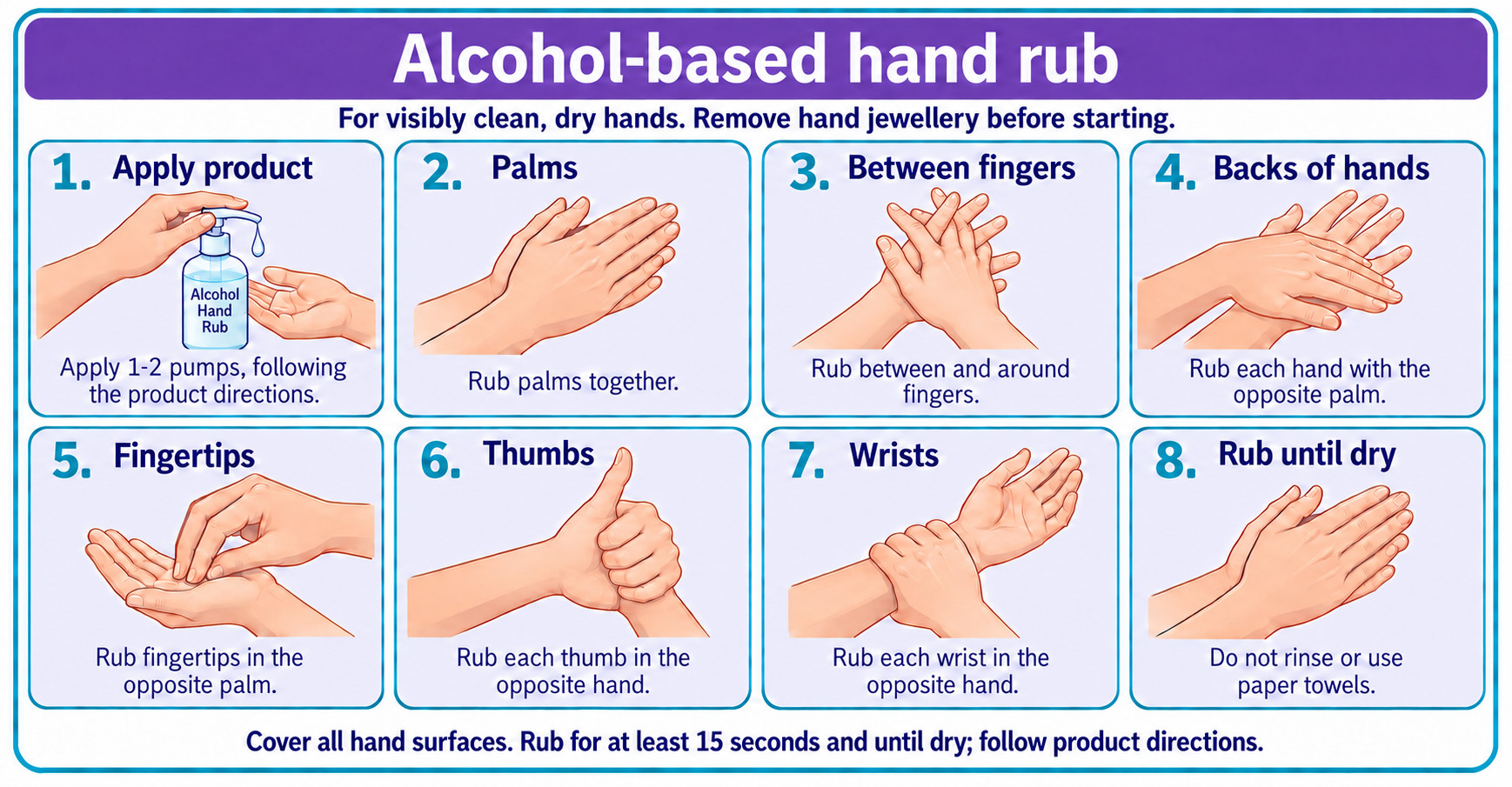
Figure 1. Alcohol-based hand-rub technique. Apply enough product to cover all hand surfaces. Rub for at least 15 seconds and until dry; follow the product directions.
Soap and Water
- Wet hands with warm running water.
- Apply enough soap to cover all surfaces.
- Vigorously rub all hand surfaces for a minimum of 15 seconds. The complete handwashing procedure, including wetting, lathering, rinsing and drying, may take approximately 40–60 seconds.
- Rinse hands thoroughly under running water.
- Dry hands completely with single-use paper towel.
- Use the paper towel to turn off the tap if not foot- or sensor-operated. Discard.
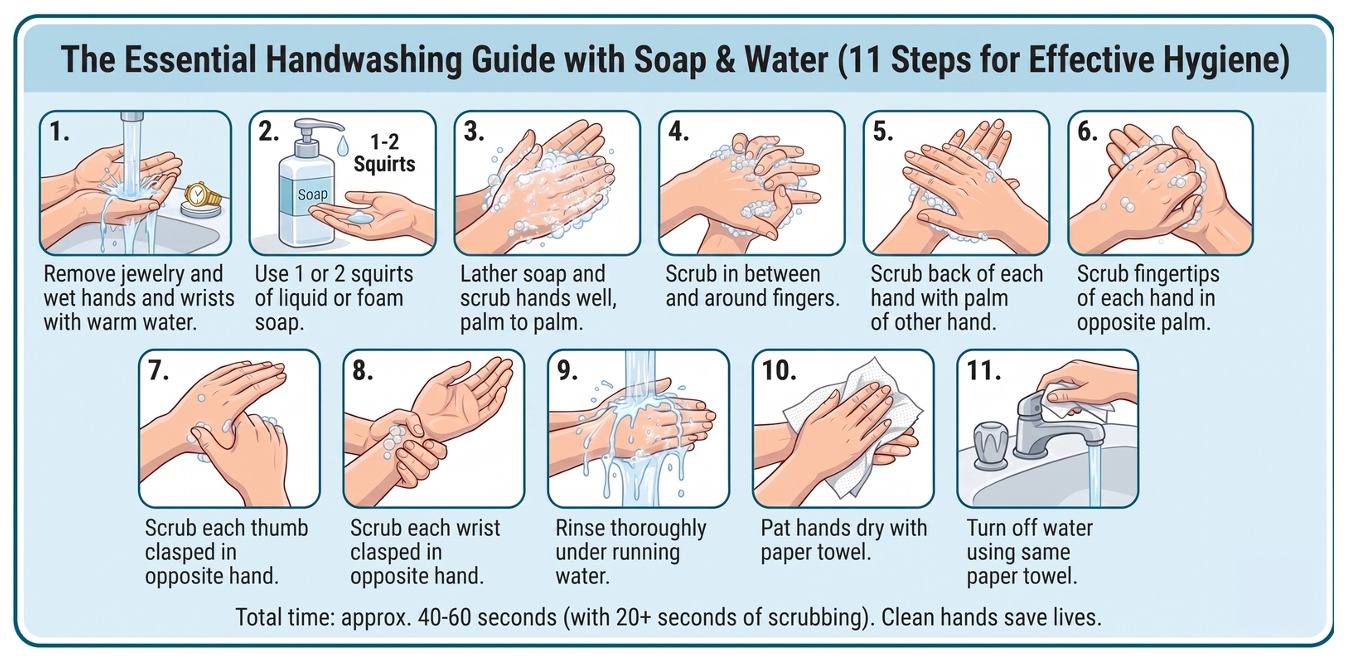
Figure 2. Handwashing with soap and water. Lather and rub all surfaces for at least 15 seconds, rinse and dry with a disposable towel. The sequence may take approximately 40–60 seconds.
10.5 Hand Care & Dermatitis Management
Healthy, intact skin is essential for IPAC. Staff are encouraged to use Clinic-supplied moisturizer regularly. Staff with dermatitis, cracked or weeping skin, or open lesions on the hands or forearms must report the condition to the IPAC Lead. During work, every area of non-intact skin must be covered with a waterproof bandage, transparent film dressing or other protective dressing and changed as needed. When non-intact skin is located on the hands, gloves must also be worn for clinical care and contaminated-item handling. Large cuts may require medical assessment and re-evaluation of work duties.
CLINIC POLICY: A worker with a lesion that cannot be securely covered must not provide direct patient care pending a case-specific occupational-health assessment.
10.6 Nail, Hand, and Wrist Policy
- Natural nails are clean and kept short, with the nail tip less than 0.6 cm (¼ inch) long. RCDSO requires clean, short nails but does not prescribe this numerical limit.
- RCDSO STANDARD: Artificial nails and nail enhancements must not be worn by OHCWs who have direct patient contact. As a policy this Clinic treats gel polish, Shellac, nail jewellery and nail extenders as prohibited nail enhancements.
- Nail polish is permitted only if intact, freshly applied, and removed/replaced when chipped.
- Before performing hand hygiene or direct patient care, hand jewellery must be removed. Arm jewellery, including watches, must be removed or pushed above the wrist. CLINIC POLICY, Rings, including wedding bands, must not be worn during direct patient care.
- Sleeves should not interfere with hand hygiene, glove cuffs or patient care and must be kept away from the patient-care field. Where the Clinic requires a bare-below-the-elbows policy, it must be identified as an enhanced Clinic policy.
10.7 Handwashing Sinks
Dedicated handwashing sinks are provided in the clinical area, separate from instrument-cleaning sinks. Each handwashing sink must provide warm running water, liquid or foam soap in a disposable container, single-use paper towels and an accessible waste receptacle. Hands-free, wrist- or elbow-operated taps and dispensers are preferred where installed. Handwashing sinks must not be used for instrument cleaning, decontamination or disposal of contaminated fluids.
At this Clinic
- Designated handwashing sinks: [Handwashing Sinks]
- Paper towels (product, and where refills are kept): [Paper Towels]
10.8 Hand Hygiene Audit
The RCDSO recommends that there should be a program to monitor, evaluate and improve hand-hygiene compliance, with feedback to individual employees and managers.
Under the Clinic’s audit schedule in §4.1, the IPAC Lead records at least 10 hand-hygiene observations each month. This frequency and sample size are Clinic quality-improvement controls, not RCDSO-prescribed minimums.
ABHR PLACEMENT: Keep alcohol-based hand rub readily accessible at the point of care. The Clinic’s placement plan should provide convenient access in operatories and other clinical areas without creating fire, ingestion or environmental hazards. PHO audit tools specifically check for point-of-care placement.
11. Personal Protective Equipment (PPE)
PRIMARY AUTHORITIES: RCDSO IPAC Standard; PHO dental/clinical-office checklists, Routine Practices, ARI guidance and clinical-office ORA.
PCRA: Operational Procedure (before every interaction)
RCDSO STANDARD / PHO BEST PRACTICE: Before every interaction with a patient or the patient’s environment, each OHCW personally completes a brief, task-specific point-of-care risk assessment (PCRA). Repeat it whenever the task, patient condition, environment or available controls change. The PCRA is not a diagnostic exercise: act on known or suspected transmission risk and on signs or symptoms pending diagnosis. Its result determines hand hygiene, PPE, patient placement and source control, procedure modification, equipment/environmental controls, and whether care may proceed, should be deferred or should be referred.
PCRA and the Clinic’s organizational risk assessment (ORA)
| Assessment | Who and when | Purpose |
|---|---|---|
| PCRA | Each OHCW, before every patient interaction or task; reassess as conditions change. | Applies established controls to the immediate patient, task and environment; selects any additional PPE or precautions. |
| ORA / workplace hazard assessment | Employer, principal dentist and IPAC/OHS lead; PHO recommends at least annually and whenever threats, services, workflow or audit findings change. | Establishes clinic-wide engineering, administrative and work-practice controls, supplies, ventilation, training and the respiratory-protection program. A PCRA cannot waive these controls. |
Seven-step PCRA
- Check current information. Review the available screening and medical-history information; the patient’s report and presentation; known or suspected infection or colonization; relevant exposure or outbreak information; and current PHO, local PHU and Clinic alerts. Look for syndromes that require action before a diagnosis, including new or worsening respiratory symptoms, fever or chills, vomiting or diarrhoea, rash, conjunctivitis, or uncontained drainage. Do not use a fixed travel look-back unless current epidemiology or disease-specific direction makes travel relevant.
- Define the interaction. Identify the planned examination, procedure or task; duration and proximity; staff and companions involved; instruments, devices and materials; whether a sterile field is required; and whether the procedure may increase respiratory-particle generation.
- Identify anticipated exposure. Ask whether hands, skin, clothing, eyes, nose or mouth may contact blood, saliva, other secretions or excretions, tissue, mucous membranes, non-intact skin, contaminated instruments, equipment or surfaces. Assess splash/spray, respiratory-particle, sharps and hazardous-product exposure separately.
- Assess patient and worker factors. Consider the patient’s ability to perform hand hygiene, tolerate source-control masking, contain coughing, secretions, drainage or diarrhoea, and cooperate safely with care. Consider relevant susceptibility or immune status of the patient and OHCW, worker restrictions or accommodations, and whether an accompanying person could enter the exposure zone.
- Confirm the environment and controls. Confirm the room or placement, separation and traffic plan, ventilation or closed-door requirement, clean-to-dirty workflow, point-of-care hand hygiene, rubber dam/high-volume evacuation where applicable, dedicated equipment, cleaning process, and immediate availability of the required PPE and a worker’s fit-tested respirator model when indicated.
- Select and apply controls. Use the hierarchy of controls: defer, modify or refer where that removes an avoidable risk; then apply placement/source control, engineering and administrative controls, safe work practices and PPE. Don the selected PPE before entering the exposure zone or starting the procedure. The PCRA selects the appropriate mask or respirator; it does not make mask use optional during a dental procedure or reduce disease-specific precautions.
- Pause, reassess and communicate. Stop and repeat the PCRA if symptoms, patient cooperation, the procedure, contamination, PPE integrity, staffing or the environment changes. Add or replace controls before continuing. Communicate required Additional Precautions to involved staff and any receiving service without disclosing more health information than necessary.
PCRA action guide
| PCRA finding or task | Minimum action before starting |
|---|---|
| Every dental procedure | Perform hand hygiene and wear an appropriate medical mask or required respirator covering the nose and mouth. Select the medical-mask performance level through the PCRA. Add gloves, eye/face protection and protective clothing as indicated below. |
| Hands may contact blood, saliva, mucous membranes, non-intact skin or contaminated items | Wear task-appropriate gloves; perform hand hygiene before donning and immediately after removal; change between patients and between contaminated and clean tasks. |
| Splash or spray; or a dental procedure with increased ARI-transmission risk | Wear a medical mask or required respirator, eye protection, gloves and gown/protective clothing. PHO identifies ultrasonic scalers, high-speed rotary handpieces, three-way syringes and air polishers as dental procedures that may increase risk; staff within two metres use this minimum ensemble. Use rubber dam and high-volume evacuation where applicable. |
| Direct care of suspected or confirmed acute respiratory infection (ARI) | At minimum, wear a medical mask, eye protection, gloves and gown. Provide patient source-control masking if tolerated and not contraindicated; separate/place promptly; defer non-urgent care. Escalate to a fit-tested, seal-checked N95 when the organism, current RCDSO/PHO/PHU direction, the Clinic’s ORA or the respiratory-protection program requires it. |
| Known or suspected airborne or novel respiratory pathogen | Apply current disease-specific Additional Precautions, including a fit-tested, seal-checked respirator where directed. Defer non-urgent treatment; consult Public Health and refer urgent care to a facility with the required airborne controls when the dental office cannot provide them. |
| Procedure within the manual’s §27 invasive/surgical category | Use sterile gloves and sterile gown plus mask, eye protection and hair cover under this manual’s adopted practice requirement; follow the specific major-surgery requirements in §27.2. |
| Instrument reprocessing or hazardous-product task | Use the workplace hazard assessment, product label/MIFU and SDS in addition to the infection PCRA. Select utility gloves, eye/face protection, protective clothing, ventilation and emergency controls for the actual chemical and task; confirm eyewash access. |
DO NOT START NON-URGENT CARE: If a required control, PPE item, room placement, fit-tested respirator or competent support is unavailable, or the transmission risk cannot be resolved, pause. Separate and source-control the patient as indicated, notify the dentist/IPAC Lead, and defer or refer the care. Follow emergency obligations and current medical-officer-of-health or PHU direction.
CLINIC DOCUMENTATION RULE: Document the active screening result, including a negative result, in the patient record. A separate narrative entry is not required for every routine PCRA that results in the Clinic’s standard controls. Record the trigger, material findings, precautions, decision, communications and reassessment when a screen is positive; Additional Precautions or non-routine respirator use is required; care is deferred, modified or referred; controls depart from normal workflow; an exposure or PPE breach occurs; Public Health is consulted; or the information is otherwise clinically relevant. Keep worker medical and occupational details in the confidential OHS record, not the patient chart. Current law, PHU direction or Clinic policy may require additional documentation.
PHO CHECKLIST / MANUAL REQUIREMENT: PCRA plus procedure-specific requirements. For a procedure meeting this manual’s §27 invasive/surgical category, use sterile gloves and gown, plus a mask, eye protection and hair cover, consistent with PHO dental checklist item 5.3. PHO classifies item 5.3 as Medium Risk, not a Legislated Requirement. RCDSO expressly requires surgical hand hygiene, sterile gown and sterile gloves for major surgical procedures, including osteotomies and rigid internal fixation. The PCRA determines mask performance, the form of eye protection and any Additional Precautions. This manual adopts the complete PHO ensemble as its practice requirement for the §27 category.
CLINIC PURCHASING POLICY: The material preferences and voluntary product standards in §11.1 are purchasing specifications unless a binding rule, current public-health direction or product MIFU makes a feature mandatory.
At this Clinic
- Task PPE guide (where it is posted): [Task PPE Guide]
11.1 Gloves
| Glove Type | Specification | Used For |
|---|---|---|
| Single-use exam gloves | Clinic preference: powder-free, appropriately sized nitrile examination gloves meeting the Clinic’s verified procurement specification. Latex-free options must be available where indicated. For environmental cleaning, use disposable examination gloves only when the task assessment and the product SDS or label confirm that they provide appropriate protection; otherwise use a compatible durable utility glove. | Routine clinical patient care; environmental cleaning only where task and chemical compatibility have been confirmed. |
| Sterile surgical gloves | Sterile, individually packaged, appropriately sized surgical gloves meeting the Clinic’s verified procurement specification. | Procedures within the manual’s §27 invasive/surgical category. PHO dental checklist item 5.3 is Medium Risk, not a Legislated Requirement; this manual adopts the complete ensemble as its practice requirement. |
| Heavy-duty utility gloves | Puncture-resistant for manual instrument cleaning. Where chemicals are used, select a durable polymer glove that is compatible with the product SDS, product label and glove manufacturer’s chemical-compatibility information. Reuse only where permitted by the glove MIFU. Assign reusable gloves to an individual where practicable; clean, disinfect and store them dry after use; replace them when damaged, degraded or as directed by the MIFU. | Manual cleaning of contaminated instruments, dirty-sink work and other wet or chemical tasks identified through the workplace hazard assessment. |
| Vinyl gloves | CLINIC PURCHASING POLICY: not selected for clinical patient care; may be used only for brief low-risk non-clinical tasks where appropriate. | Reception/non-clinical only. |
11.2 Glove Use Rules
- Don clean gloves immediately before the task when contact with mucous membranes, non-intact skin, blood, saliva or other body fluids, contaminated instruments or materials is anticipated.
- Change gloves between patients and whenever moving from a contaminated to a clean task on the same patient.
- Remove gloves immediately after the task; perform hand hygiene immediately after removal.
- Do not wash, decontaminate, or reuse single-use exam or surgical gloves.
- Do not leave the operatory or touch clean surfaces (door handles, keyboards, charts, telephone) wearing contaminated gloves.
11.3 Masks and Respirators: Selection by PCRA
RCDSO STANDARD: An appropriate mask that covers the nose and mouth must be worn by OHCWs during every dental procedure. The PCRA selects an appropriate medical-mask performance level or determines that a fit-tested, seal-checked respirator is required; it does not make mask use optional during a dental procedure. Select greater fluid resistance when heavy droplets, splatter or spray are anticipated. ASTM Levels 1, 2 and 3 are all medical-mask performance categories; no fixed ASTM level is a universal RCDSO rule.
CLINIC POLICY: The Clinic may establish ASTM Level 1 as its minimum medical mask, use ASTM Level 2 for moderate fluid exposure, and use ASTM Level 3 as its default for heavy-splash procedures. These are Clinic purchasing/use defaults, not universal RCDSO requirements, and they do not replace a respirator when one is required.
A fit-tested, seal-checked N95 respirator approved by NIOSH or CSA, or another respirator meeting O. Reg. 833, s. 10, is worn whenever required by Airborne Precautions, current PHO or Public Health Unit direction, the workplace respiratory-hazard assessment or the Clinic’s respiratory-protection program. Respirator use is not limited to AGMPs.
11.4 Mask Use Rules
- RCDSO STANDARD / PHO BEST PRACTICE / CLINIC PROCEDURE: Wear an appropriate mask during every dental procedure and replace it between patients and whenever wet, soiled, contaminated or damaged. The Clinic requires a fresh appropriate medical mask to be donned immediately before each dental procedure; secure the ties or ear loops, cover the nose and mouth and mould the nose piece for a snug fit. For non-procedural tasks, the PCRA determines whether a medical mask is indicated. Where a respirator is required, don the worker’s fit-tested make/model/size at the point specified by the respiratory-protection procedure and perform the MIFU seal check each time.
- Replace a medical mask whenever it becomes wet, visibly soiled or damaged and always between patients. Once removed, discard it unless a current public-health contingency protocol and the product instructions expressly permit another practice.
- Do not let the mask hang under the chin; do not touch the mask front; remove by the ties/loops only.
- Do not wear the same mask for back-to-back patients; do not wear a mask out of the operatory and back in.
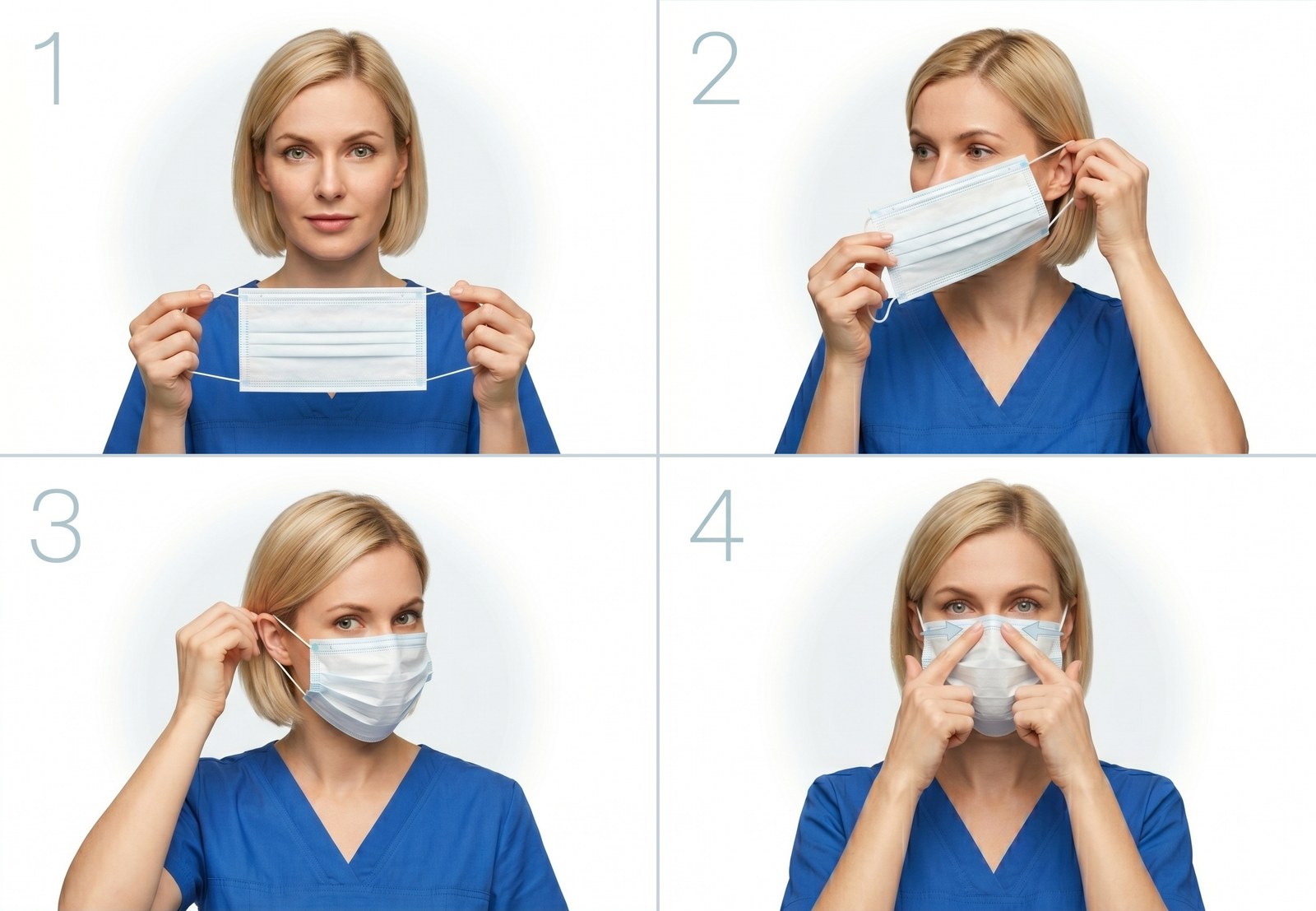
Figure 3. Medical-mask donning sequence: perform hand hygiene; handle the mask by the ties or loops; cover the nose and mouth; secure it; mould the nose piece; and adjust for a snug fit.
11.5 N95 Respirator Fit-Testing Program
FIT-TESTING REQUIRED FOR TIGHT-FITTING RESPIRATORS (INCLUDING N95): Each worker must be fit-tested before first use, at least every two years thereafter, whenever the respirator make, model or size changes, and whenever a physical change may affect fit. The Clinic follows current PHO guidance and its written respiratory-protection program.
Fit-testing is administered through the Clinic’s Respiratory Protection Program. The IPAC Lead maintains the Fit-Test Record including respirator make, model, size, test method, pass/fail, tester name, and date. Users are trained in the user-seal-check procedure, and the Clinic maintains access to sufficient respirator makes, models and sizes to obtain an acceptable fit for each worker who may be required to use a tight-fitting respirator.
11.6 Protective Eyewear and Patient Barriers
- Wraparound goggles or a face shield with side and brow protection. CLINIC PURCHASING POLICY, select impact resistance and other voluntary product specifications appropriate to the identified hazard.
- Select safety glasses or goggles that provide a barrier to splashes from the side, or a face shield/visor appropriate to the anticipated exposure. Prescription eyeglasses alone are not acceptable. CLINIC PURCHASING POLICY, Any additional top/bottom coverage or impact-resistance specification is selected through the hazard assessment and product MIFU.
- Reusable eye and face protection must be cleaned and disinfected between patients and whenever visibly contaminated, using a Health Canada-authorized product that is compatible with the equipment and used according to both the disinfectant label and equipment manufacturer’s instructions.
- Face shields and protective eyewear labelled single-use must be discarded after use. Reusable products must be reprocessed according to their manufacturer’s instructions.
- CLINIC POLICY: Patient protective eyewear. The Clinic adopts RCDSO’s recommendation: provide each patient with protective eyewear that shields the eyes from spatter and debris and have the patient wear it throughout the appointment. Clean and disinfect reusable patient eyewear after each use and whenever visibly contaminated; discard single-use eyewear after use.
- CLINIC POLICY: Patient draping. The Clinic adopts RCDSO’s recommendation: use a single-use bib or drape to protect the patient’s clothing and reduce exposure to spatter and debris; discard it after use. Reprocess any reusable holder or clip between patients according to its MIFU and contamination.
- Source reduction: Use a rubber dam whenever feasible and high-volume suction to minimize droplets, spatter and spray.
At this Clinic
- Reusable eyewear, face shields and gowns (how and where they are cleaned): [Reusable PPE Process]
11.7 Gowns and Clinical Attire
Gown and Protective-Clothing Selection: PCRA and Clinic Purchasing Policy
Protective clothing must be worn whenever splash or spray of blood, body fluids, secretions or excretions is anticipated. The gown’s coverage and fluid resistance must be appropriate to the task and selected through the PCRA. For a procedure classified as invasive/surgical under §27, use a sterile gown as part of the complete PHO ensemble.
PHO BEST PRACTICE: For dental procedures with increased ARI-transmission risk, including ultrasonic scalers, high-speed rotary handpieces, three-way syringes and air polishers, staff within two metres wear a gown, gloves, eye protection and at least a medical mask, whether or not ARI symptoms are identified. A fit-tested, seal-checked N95 may be selected by PCRA or Clinic policy and is used whenever an organism or current direction requires it.
CLINIC PURCHASING POLICY: Where gowns are required, the Clinic supplies appropriately sized, long-sleeved, cuffed gowns providing sufficient front and side coverage. AAMI Level 2 or higher may be adopted as the Clinic’s purchasing minimum but must not be represented as a universal RCDSO or PHO requirement.
REUSABLE/WASHABLE GOWNS: Reusable or washable protective gowns must be changed and laundered after each patient use. They must be laundered in a compliant on-site laundry facility or by a commercial laundry service; home laundering and laundromat use are not permitted. On-site laundering is permitted only where the required dedicated, physically separated laundry space and negative-pressure sorting area are provided. While awaiting laundering or pickup, used gowns must be placed in the designated lined laundry container. Scrubs worn only as Clinic attire may be laundered at home.
11.8 PPE Donning Sequence
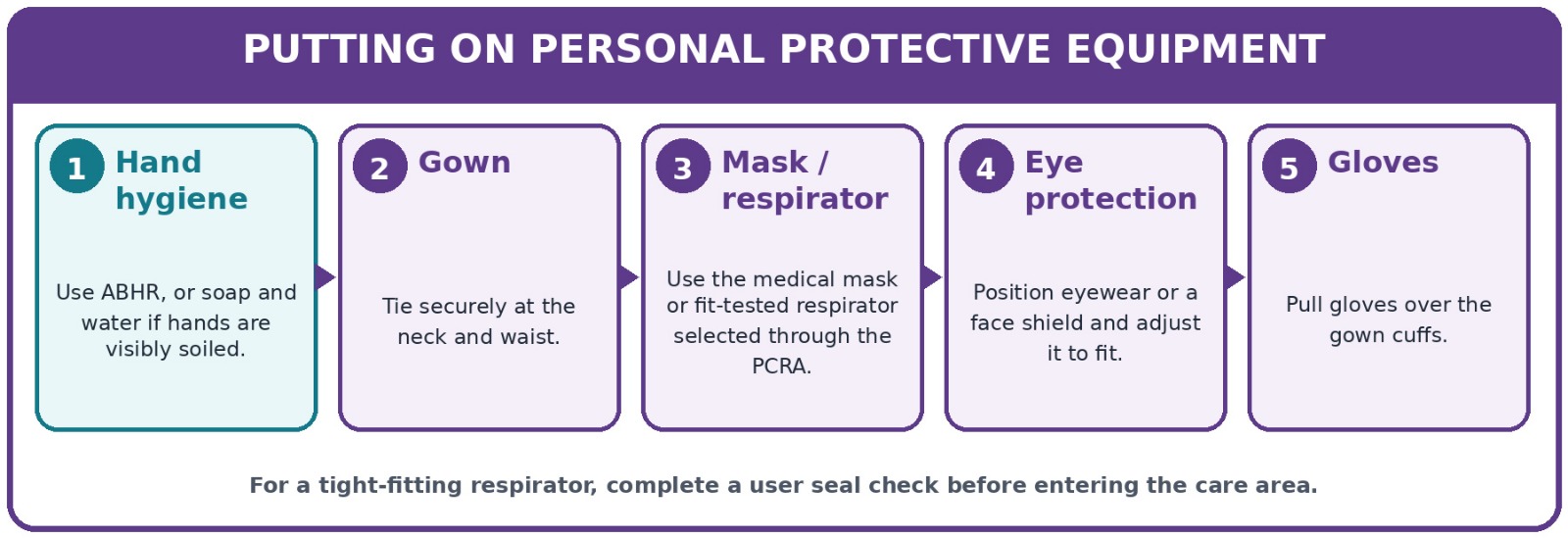
Figure 4. PPE donning sequence: perform hand hygiene; don and secure the gown; don the medical mask or fit-tested respirator selected through the PCRA; don eye protection or face shield; and don gloves, pulling the glove cuffs over the gown cuffs. For a tight-fitting respirator, perform the manufacturer-specified user seal check before entering the care area.
At this Clinic
- Where PPE is stocked: [PPE Supply Locations]
11.9 PPE Doffing Sequence
Gloves: peel from cuff, ball into palm, dispose
↓
Hand hygiene
↓
Gown: untie; pull away without touching the contaminated outer surface; turn it inward and bundle away from the body with minimal air disturbance. Discard a single-use gown in the appropriate waste receptacle or place a reusable gown in the designated laundry/reprocessing receptacle.
↓
Hand hygiene
↓
Eye protection / face shield: by the strap
↓
Mask or respirator: remove by ties, loops or straps; do not touch the front
↓
Hand hygiene
Doffing principle The “outside” of removed PPE is contaminated. Always remove the most contaminated item first (gloves), perform hand hygiene between any item where outside contact may have occurred, and finish with hand hygiene.
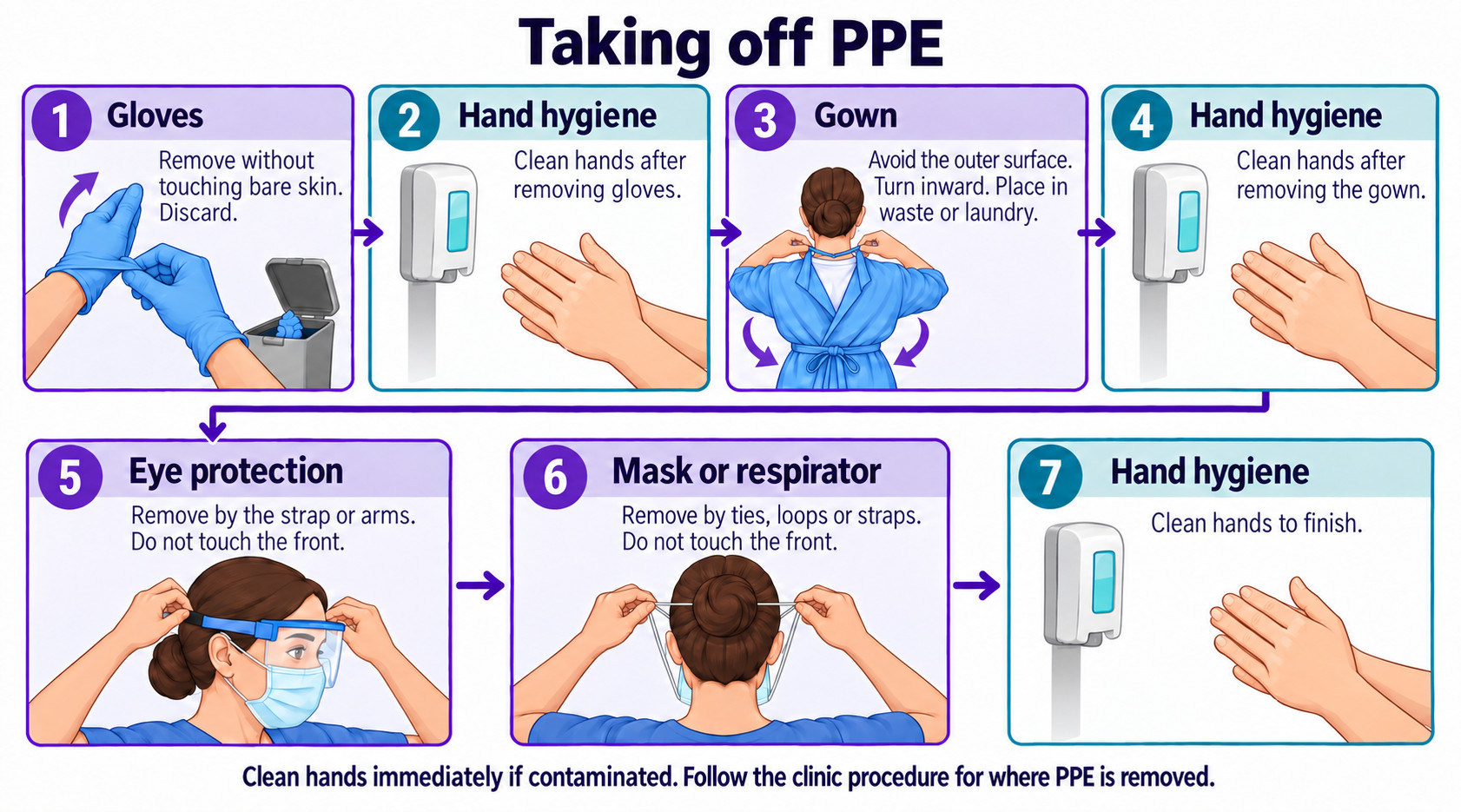
Figure 5. PPE doffing sequence used in this manual: gloves; hand hygiene; gown; hand hygiene; eye protection or face shield; mask or respirator; final hand hygiene. If bare hands become contaminated at any point, perform hand hygiene immediately.
At this Clinic
- Where PPE is removed and discarded: [PPE Removal Locations]
11.10 Latex Sensitivity and Allergy: Patients and Workers
PATIENTS
At intake and whenever the medical history changes, ask about suspected or diagnosed latex allergy. If a true latex allergy is reported or confirmed, record a prominent confidential alert; check the latex content of gloves, rubber dams, prophylaxis cups, orthodontic elastics, medication vials and other products; remove latex-containing materials from the operatory or adequately cover and isolate them; and use latex-free alternatives so direct and airborne latex-protein exposure is kept as low as reasonably achievable. If the history is uncertain, obtain appropriate clinical assessment before elective latex exposure.
WORKERS
Workers must promptly report suspected latex-related symptoms through the Clinic’s confidential occupational-health process. Irritant contact dermatitis, delayed hypersensitivity and immediate allergy require different assessment and controls. Refer delayed or immediate reactions for medical assessment; an immediate reaction requires emergency medical care. For a confirmed immediate latex allergy, use only non-latex, powder-free gloves and avoid latex products in the workplace as directed by the treating or occupational-health clinician. Document the accommodation without disclosing the diagnosis unnecessarily.
At this Clinic
- Latex-free alternatives (what is stocked, and where): [Latex-Free Alternatives]
11.11 Eyewash Stations and Eye Exposure
RCDSO STANDARD / ONTARIO LAW: An eyewash station must be available in the dental office for OHCWs and patients to aid in managing eye contact with body fluid or a dental chemical/solvent. Where a worker is required to work with, or is likely to be exposed to, a hazardous biological or chemical agent that could injure the eye or skin, O. Reg. 851, s. 124 requires the employer to provide the emergency-treatment facilities needed, including eyewash facilities, near the hazard, readily accessible, clearly marked and accompanied by instructions.
PHO CLINICAL-OFFICE CHECKLIST / CLINIC PLACEMENT RULE: Provide an eyewash fountain/station wherever biological or chemical eye injury may occur and use and manage it according to its MIFU. A plumbed or self-contained station serving the reprocessing area should be on an unobstructed route within a 10-second walk (approximately 16-17 metres / 55 feet). This 10-second placement is PHO best-practice guidance, not a distance stated in O. Reg. 851. Keep access and activation unobstructed and identify the station clearly.
At this Clinic
- Eyewash station locations: [Eyewash Stations]
Immediate response and maintenance
BODY-FLUID EXPOSURE: Begin flushing the eye immediately and thoroughly with clean water or saline, then follow §14.2, report internally and obtain prompt medical assessment. Do not delay irrigation to complete incident paperwork.
CHEMICAL EXPOSURE: Begin eyewash irrigation immediately; follow the product label, SDS and eyewash MIFU for flushing and emergency action; obtain poison-centre or emergency medical advice as indicated. Do not attempt chemical neutralization unless the product-specific emergency instruction expressly directs it.
CLINIC MAINTENANCE PROCEDURE: The IPAC/OHS Lead assigns and records inspection, activation/testing, solution replacement and servicing at the frequency specified by the station MIFU and applicable workplace requirements. Remove an expired, empty, obstructed or malfunctioning unit from service and provide an effective alternative before the hazardous task resumes.
12. Immunization & Health Surveillance
PRIMARY AUTHORITIES: RCDSO IPAC Standard and Canadian federal guidance.
Oral health-care workers should be adequately immunized against vaccine-preventable diseases relevant to their occupational duties. The Clinic conducts an occupational-risk assessment and provides workers with access to current immunization information. Any Clinic vaccination requirement must comply with applicable employment, human-rights, privacy and accommodation obligations.
12.1 Recommended Immunizations for Clinical Staff
| Vaccine | Schedule | Evidence/record to maintain (authority varies) |
|---|---|---|
| Hepatitis B | Complete a Health Canada-authorized vaccine series according to the product schedule and current Canadian Immunization Guide. Workers with reasonably anticipated blood exposure should receive post-vaccination anti-HBs testing 1–2 months after completion of the applicable series, consistent with RCDSO; this falls within the Canadian Immunization Guide’s current 1–6-month window. Arrange clinical management of an inadequate response. | Confidential vaccination and post-vaccination serologic-status record, including documented immunity or vaccine nonresponse where applicable. |
| Influenza | Annually in accordance with current Ontario Ministry of Health and NACI recommendations. | Vaccination date. |
| MMR | Evidence of immunity or vaccination in accordance with the Canadian Immunization Guide and occupational-health assessment. | Vaccination dates or acceptable evidence of immunity. |
| Varicella | Evidence of immunity or vaccination in accordance with the Canadian Immunization Guide and occupational-health assessment. | Vaccination dates or acceptable evidence of immunity. |
| Tetanus, diphtheria and pertussis | In accordance with the current Canadian Immunization Guide, including an adult pertussis-containing dose where indicated and subsequent boosters at the recommended intervals. | Vaccination date. |
| COVID-19 | In accordance with current Ontario Ministry of Health and NACI recommendations applicable to health-care workers and the individual. | Vaccination dates where collected lawfully and necessary. |
| Polio and other vaccines | Poliomyelitis: every health care worker who has not received a primary series should receive a primary series of inactivated poliomyelitis vaccine (IPV). Workers at highest risk for polio exposure should also receive one lifetime IPV booster; if previously unvaccinated, complete the primary series and give the booster 10 years later. Assess additional vaccines according to occupational exposure, travel, outbreak and public-health guidance. | Polio primary-series and booster dates, where applicable; other relevant vaccination dates or evidence of immunity. |
AUTHORITY NOTE: RCDSO specifically requires the dental office’s immunization policy to include a record of hepatitis B vaccination and documented immunity by serology for every OHCW. Records for other vaccines are maintained only where reasonably necessary and lawful under clinic policy, privacy, human-rights and accommodation obligations.
12.2 Immunization Declaration & Refusal
At hire and periodically thereafter, the Clinic provides workers with information about recommended occupational immunizations and offers a confidential mechanism to document vaccination or informed declination where collection is reasonably necessary. RCDSO RECORDKEEPING, For every OHCW, maintain a confidential record of hepatitis B vaccination status and documented post-vaccination serologic status, including immunity or vaccine nonresponse where applicable. Detailed medical information is limited, protected and accessible only to authorized persons.
12.3 Tuberculosis Screening
Baseline TB screening shall follow the current Canadian Tuberculosis Standards. Every OHCW should receive a baseline individual TB risk assessment and symptom evaluation and, unless the worker has documented previous TB disease or latent TB infection, a baseline TST. Use a two-step TST unless there is documentation of a previous negative two-step TST, in which case a single-step TST may be used. Do not conduct routine periodic testing of every baseline-negative worker; subsequent testing is based on the setting’s risk assessment, a recognized exposure or Public Health or occupational-health direction. Following an unprotected exposure, conduct a symptom assessment and repeat the TST eight weeks after exposure for a worker whose baseline TST was negative. IGRA should not be used for serial worker testing. Record results confidentially.
12.4 Bloodborne-Infected and Immunocompromised Workers
BLOODBORNE INFECTION: OHCWs who might perform exposure-prone procedures have an ethical obligation to know their relevant serologic status. An infected OHCW must use a confidential occupational-health pathway for case-specific assessment. An infected dentist who performs or might perform exposure-prone procedures must seek RCDSO guidance regarding the potential for transmission to patients; other regulated OHCWs must also consult their regulator where applicable. Determine any work restriction or modification individually rather than imposing a blanket exclusion solely because of infection status. Limit access to the worker’s medical information to those who need it for lawful risk management and accommodation.
IMMUNOCOMPROMISED WORKERS: Arrange an individualized occupational-health assessment of the worker’s job functions, infection-exposure risks and any risk of prolonged viral shedding that is relevant to the condition. Where feasible, implement reasonable task or exposure modifications and review them when the worker’s condition, duties or workplace risks change.
13. Healthy Workplace, Sick Leave & Return to Work
PRIMARY AUTHORITIES: RCDSO, PHO disease-specific/clinical-office/ARI guidance and Ontario WHMIS requirements.
REQUIRED: Communicable-Illness and Work-Restriction Policy Staff must promptly report symptoms or diagnoses that could create a transmission risk. Exclusion, work restriction, masking, reassignment and return-to-work decisions are made using current disease-specific public-health and occupational-health guidance, the worker’s duties and the risk to patients and co-workers.
13.1 Stay-Home Criteria
| Symptom / Condition | Work Restriction / Return-to-Work |
|---|---|
| Fever | Exclude while febrile or too unwell to work. Return when fever and other symptoms meet the current disease-specific return-to-work criteria without relying on symptom-suppressing medication. |
| Respiratory symptoms | Follow current PHO, Ministry of Health, Public Health Unit and occupational-health guidance. Symptoms should be improving and fever resolved; source-control masking or reassignment may be required after return. |
| Vomiting or diarrhoea | Exclude while symptomatic and for the period required by the suspected cause and current public-health guidance. A 48-hour symptom-free period may be adopted as Clinic policy where appropriate but is not a universal RCDSO rule for every cause. |
| Conjunctivitis | Work restriction depends on the suspected cause, symptoms, treatment and ability to avoid contamination. Obtain clinical or public-health advice where needed; do not apply an automatic universal 24-hour rule. |
| COVID-19, influenza or RSV | Apply current disease-specific Ontario and local Public Health Unit guidance. Contact assessment is undertaken only where clinically or legally indicated. |
| Open draining lesion | Cover securely where possible and restrict direct patient care if the lesion cannot be completely contained or creates a contamination risk. |
| Active respiratory TB | Exclude from the workplace until the treating clinician and Public Health determine that the worker is no longer infectious and may safely return. |
13.2 Reporting
Staff report illness to the IPAC Lead (or designate) before the start of their shift. The IPAC Lead documents the report in the Confidential Work Restriction and Clearance Log (Appendix J Form J-27), arranges coverage, and assesses whether occupational-health, infection-control or Public Health consultation is required. Patient or staff contact identification is undertaken only where indicated by the disease, exposure assessment or Public Health direction.
At this Clinic
- Occupational-health provider (name and contact): [Occupational Health Provider]
13.3 Return to Work
Return to work following a communicable illness is determined case by case under the Clinic’s policy and current disease-specific Ontario and local Public Health Unit guidance. Treating-clinician, occupational-health or Public Health Unit assessment or clearance is obtained when clinically indicated, legally required or specifically directed. Written clearance from both a treating clinician and Public Health Unit is not automatically required. The Clinic requests and retains only the information reasonably necessary to determine fitness for work, restrictions or accommodation.
RCDSO requires exclusion until symptoms have subsided and the applicable communicability period has passed; it does not impose universal clinician clearance for every routine illness.
At this Clinic
- Who clears a return to work after illness, and how: [Return-to-Work Procedure]
13.4 WHMIS and Hazardous Products
LAW / RCDSO STANDARD: The Clinic complies with the Occupational Health and Safety Act and R.R.O. 1990, Reg. 860 (WHMIS). Hazardous products, including cleaning and disinfecting agents, must have the required supplier or workplace label; current safety data sheets (SDS) must be readily available to workers; and workers must receive product- and task-specific education and training before use and when hazard information or work changes.
CLINIC PROCEDURE: Maintain a current hazardous-product inventory linked to the SDS file. Keep supplier labels legible; apply a workplace label whenever WHMIS requires one; never leave a transferred or decanted product unidentified. Before use, read and follow the label, SDS and MIFU for dilution or mixing, incompatibilities, ventilation, PPE, storage, spill response, first aid and disposal. Do not use a product with missing hazard information. Report a missing/damaged label, unavailable SDS, spill or exposure immediately. Record worker training and retraining.
13.5 Food, Beverages, Cosmetics and Contact Lenses
PROHIBITED ACTIVITIES: RCDSO prohibits eating and drinking in operatories, instrument-reprocessing areas and in-office dental laboratories. Storing food, smoking, applying cosmetics or lip balm, and handling contact lenses are also prohibited in patient-care areas (including operatories) and the reprocessing area. Consume and store food and beverages only in a designated clean staff area or outside the dental office; never store them in a refrigerator used for biomedical waste, drugs or clinical supplies.
14. Exposure Control Plan & Post-Exposure Management
PRIMARY AUTHORITIES: RCDSO, PHO clinical-office guidance, Ontario OHSA/WSIB requirements and federal PEP guidance.
MANDATORY: OHSA + RCDSO Every needlestick, sharps injury and potentially significant mucous-membrane or non-intact-skin exposure must be reported internally immediately and promptly assessed. External reporting to WSIB, MLITSD, a Public Health Unit or another authority occurs only when the applicable statutory reporting criteria are met. The procedure below is followed without exception.
14.1 Definition of a Significant Exposure
A significant exposure is any of the following:
- Percutaneous injury (needlestick, cut, puncture) involving an instrument that may have been contaminated with blood, saliva or other body fluid.
- Splash or splatter of blood, saliva or other body fluid to the eyes, nose or mouth (mucous membrane exposure).
- Splash or splatter of blood, saliva or other body fluid to non-intact skin (open lesion, fresh cut or dermatitis).
- Human bite that breaks the skin.
This is the threshold for immediate reporting and prompt assessment. The assessing clinician determines the actual bloodborne-pathogen transmission risk and whether baseline testing, follow-up or post-exposure prophylaxis is indicated.
14.2 Immediate Steps (within minutes)
| Exposure | Immediate action |
|---|---|
| Needlestick, cut or puncture | Allow the wound to bleed briefly and freely; do not squeeze it. Wash with soap and water and cover it. |
| Eye, nose or mouth | Flush immediately and thoroughly with copious clean water or saline. |
| Non-intact skin | Wash immediately with soap and water. |
Report the incident internally at once and obtain urgent medical assessment. Do not scrub the wound or apply bleach or another caustic agent.
At this Clinic
- Who to tell immediately after an exposure, and the backup: [Exposure Reporting Contact]
- Where an exposed person goes for urgent assessment, including after hours: [Urgent Exposure Assessment]
14.3 Source-Person Assessment
RCDSO STANDARD: Any occupational injury must be reported to a dentist in the practice. In every significant exposure, the dentist must promptly assess the source patient’s status and risk for blood-borne illness by reviewing the medical history and, if necessary, asking focused additional questions. If HBV, HCV or HIV status is unknown, or known risk factors are present, seek the source patient’s cooperation to clarify the information and make every reasonable effort to obtain informed consent for appropriate testing or medical referral. At the same time, refer the exposed worker urgently for confidential medical assessment, baseline testing and consideration of post-exposure prophylaxis.
The dental office should provide the clinician with relevant facts concerning the exposure but should not conduct an unnecessary detailed sexual- or substance-use history. A source person may decline testing. Where the source person declines, cannot be identified or cannot be tested promptly, the exposed worker is managed as having an unknown source status.
14.4 Post-Exposure Prophylaxis (PEP)
| Pathogen | Post-Exposure Management |
|---|---|
| HBV | Risk and post-exposure management depend on the source’s HBV status and the worker’s vaccination and documented immunity. Obtain urgent medical assessment. HBIG, vaccination or further testing is provided when indicated by the current occupational-exposure protocol. |
| HCV | No post-exposure prophylaxis is recommended. Obtain urgent medical assessment. Baseline and follow-up HCV testing are selected and directed by the assessing clinician under the current occupational-exposure protocol. |
| HIV | Obtain urgent medical assessment. Where HIV PEP is indicated, it should begin as soon as possible and no later than 72 hours after exposure and is generally continued for 28 days unless the assessing clinician directs otherwise. Baseline and follow-up testing follow the current occupational-exposure protocol. |
14.5 Documentation and External Reporting
Report every exposure internally immediately and document it promptly. Before applying WSIB reporting rules, confirm whether the Clinic’s business activity and the affected worker or other person are covered. Offices of dentists are generally eligible for by-application WSIB coverage rather than automatically covered. The WSIB paragraphs below apply only where coverage exists. Subject to the special needle-stick rules below, where WSIB’s general reporting criteria are met, health care, absence from regular work, reduced earnings, modified work at less than regular pay, or modified work at regular pay for more than seven calendar days, the Clinic must ensure that WSIB receives a complete accident report within three business days after the Clinic learns of the reporting obligation and must provide the worker with a copy. CLINIC POLICY, the IPAC Lead maintains the Exposure Incident Log and reviews aggregate trends quarterly.
MINIMUM CONFIDENTIAL EXPOSURE RECORD: Record the exposed worker and vaccination status; date and time; procedure; nature and extent of the exposure; immediate action taken; source-person identity and known or suspected status, where lawfully collected and necessary; and follow-up counselling and management. All OHCWs must know the exposure protocol and review it periodically.
WSIB: needle-stick exposure (where WSIB coverage applies). Apply WSIB’s special needle-stick reporting rules in addition to the general accident-reporting criteria. Where the Clinic follows a documented surveillance protocol and the worker tests negative without receiving treatment, an accident report is not required. The Clinic must report where the worker tests positive, receives treatment related to the incident, including HIV post-exposure prophylaxis, claims an emotional or anxiety-related response, or declines the surveillance protocol. A Clinic that does not follow a surveillance protocol must report an exposure or suspected exposure to infectious disease through a needle-stick injury. When reporting is required, WSIB must receive the complete accident report within three business days after the Clinic learns of the reporting obligation, and the worker must receive a copy.
OHSA notice. Independently of WSIB reporting, the Clinic shall assess whether written notice is required under section 52 of the Occupational Health and Safety Act and Ontario Regulation 420/21. The applicable duties and recipients differ for a workplace accident that prevents a worker from performing usual work or requires medical attention, and for an occupational illness or occupational-illness WSIB claim. Complete any applicable prescribed notice within the four-day period required by the Act and provide it to every recipient required by the Act and regulation.
14.6 Follow-up
The IPAC Lead may track whether required medical follow-up has been completed but must not direct clinical treatment or routinely retain detailed diagnostic results. Testing, counselling and treatment are managed confidentially by the worker’s medical or occupational-health provider. The Clinic receives only information reasonably necessary for workplace safety, accommodation and reporting.
15. Sharps Safety & Bloodborne Pathogen Program
PRIMARY AUTHORITIES: RCDSO IPAC Standard and O. Reg. 474/07.
MANDATORY FOR HOLLOW-BORE NEEDLES (O. Reg. 474/07): When a worker performs work requiring the use of a hollow-bore needle, the employer must provide, and the worker must use, a safety-engineered needle appropriate for the work. The employer’s duty to provide one does not apply where the employer is unable, despite reasonable efforts, to obtain an appropriate safety-engineered needle. A worker may use a conventional hollow-bore needle where the worker believes on reasonable grounds that, in the particular circumstances, the safety-engineered needle would pose a greater risk of harm. The employer must provide training to assist workers in applying this exception.
A further narrow exception under s. 5 applies only where all of the following conditions are satisfied:
- A declared emergency is in effect in that part of Ontario, or a situation exists that constitutes or may constitute a serious risk to public health;
- The employer’s supply of appropriate safety-engineered needles has been exhausted; and
- The risk of postponing the work until an appropriate safety-engineered needle becomes available is greater than the risk of using a conventional hollow-bore needle.
CLINIC POLICY: Document any use of a conventional hollow-bore needle and the applicable reason in the occupational-health and safety record. Record it in the patient chart only where clinically relevant.
15.1 Additional Clinic Sharps-Safety Measures
LEGAL DEFINITION: Under O. Reg. 474/07, a safety-engineered needle is a hollow-bore needle designed to eliminate or minimize worker skin-puncture risk and licensed by Health Canada, or a licensed needleless device that replaces a hollow-bore needle. A sheath, recapping aid or syringe design is not automatically a compliant safety-engineered needle unless the device meets this definition. The measures below supplement, but do not replace, the statutory requirement.
- Local anaesthetic syringes with retractable or sheathed needle covers.
- Suture needles with built-in safety tabs where surgical procedures are performed.
- Safety scalpels with retractable blade or sheath.
- Needle recapping devices (one-handed) where recapping is unavoidable for legitimate procedural reason.
15.2 One-Handed Scoop Technique
Recapping is to be avoided whenever possible. Where recapping is unavoidable (e.g., between injections on the same patient), the one-handed scoop technique is used: place the cap on a flat surface, slide the needle into the cap using only the syringe hand, then secure the cap. Never recap two-handed.
15.3 Sharps Container Specifications
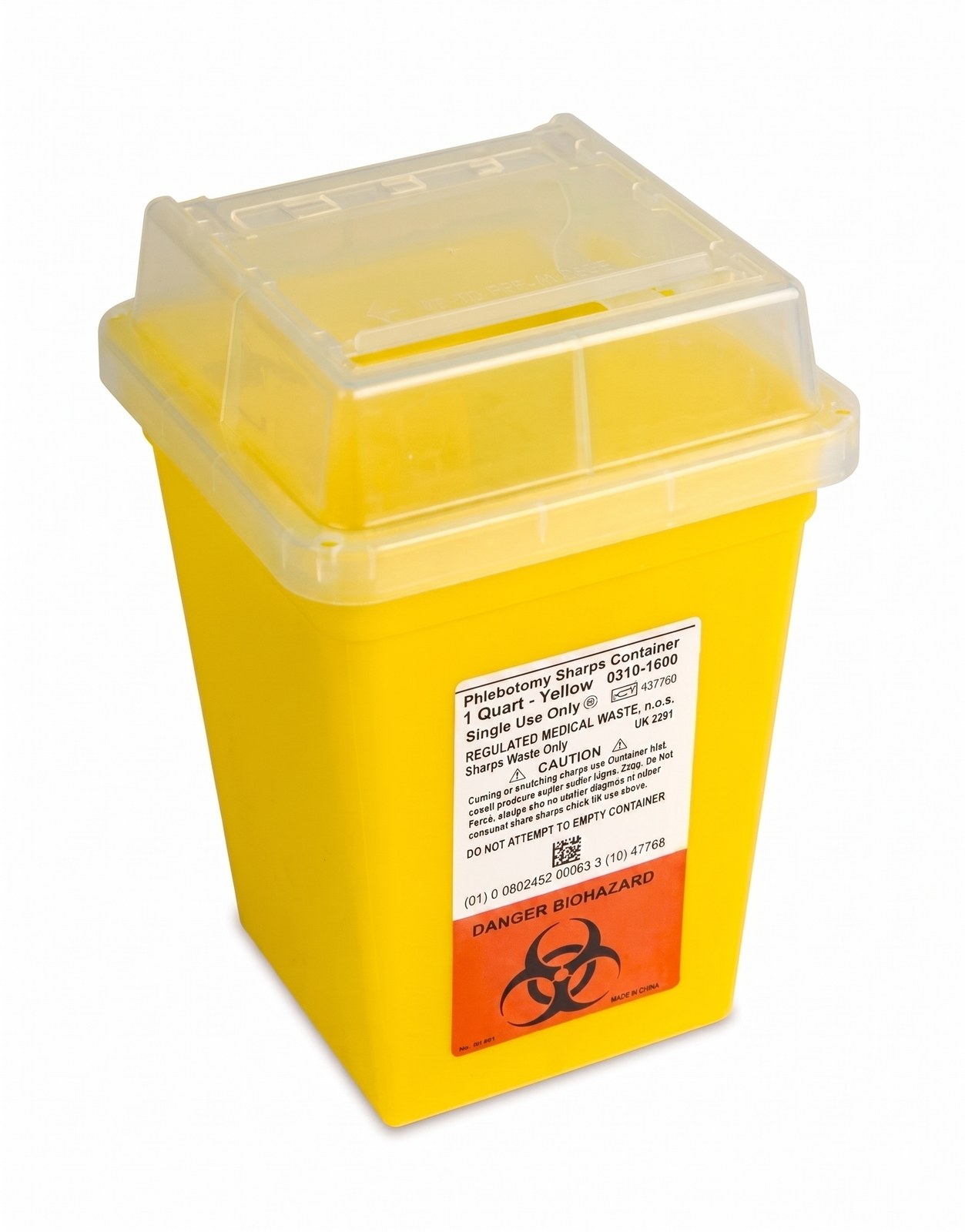
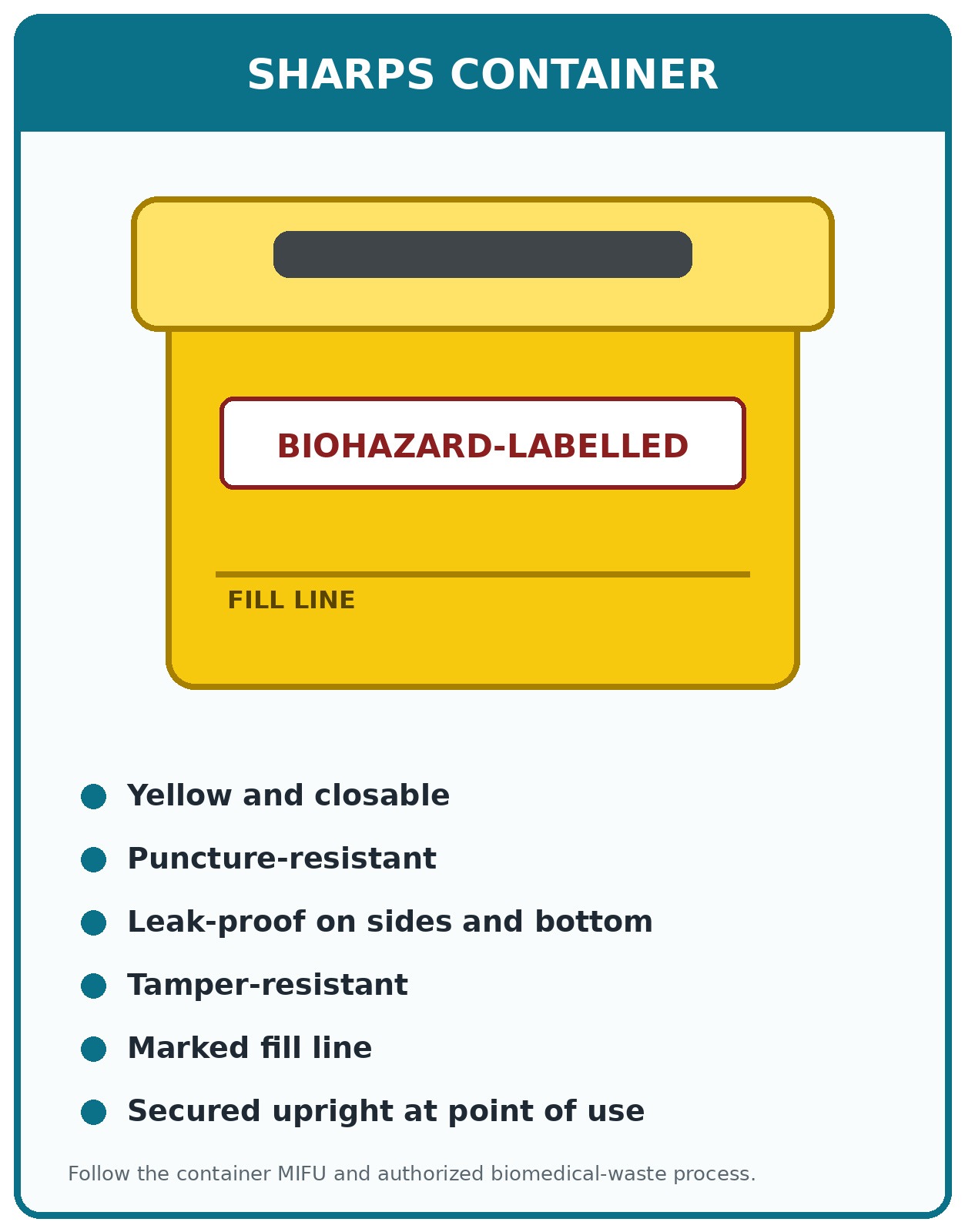
At the point of removal, place dental sharps in a purpose-designed yellow container that is puncture-resistant, leak-proof, closable and labelled with the universal biohazard symbol. CLINIC POLICY, Use a tamper-resistant container. Keep it upright and secure; never fill it past the marked fill line; close and replace it at the fill line, when damaged or as its instructions require; and use the authorized biomedical-waste system.
CLINIC POLICY: Mounting height, the number and exact placement of containers, and any maximum in-service period are set by the Clinic’s risk assessment and the container and waste-provider instructions. The required yellow colour and biohazard labelling are not optional Clinic preferences.
At this Clinic
- Sharps container locations: [Sharps Container Locations]
15.4 Sharps Handling Rules
- Place sharps in the container immediately after use. Do not pass uncapped sharps between staff.
- Do not bend, break, or shear needles.
- Do not retrieve items from a sharps container.
- Do not place a sharp on a tray expecting another person to deal with it.
- Remove burs from handpieces immediately after the procedure using a safe method. Before a tray or cassette enters the instrument-cleaning workflow, identify and remove all disposable sharps without reaching blindly or handling unseen sharps.
- CLINIC POLICY: Inspect each sharps container at the start of every shift and replace it if it is at the fill line, damaged or otherwise due for replacement.
| Sharps container: verified requirements | |
|---|---|
| RCDSO minimums: purpose-designed; yellow; puncture-resistant; leak-proof; labelled with the universal biohazard symbol. | Clinic operation: closable and tamper-resistant; marked fill line; upright and secured at point of use; replace at fill line or sooner if damaged; follow the container MIFU and authorized biomedical-waste process. |
 |
 |
|---|
Figure 6. Core features of the Clinic’s sharps container. The tamper-resistant specification is an adopted Clinic control; follow the exact container MIFU and authorized biomedical-waste process.
15.5 Sharps Injury Reporting
Every sharps injury is managed under Chapter 14: Exposure Control Plan & Post-Exposure Management and documented in the Clinic’s exposure record. CLINIC POLICY, the IPAC Lead reviews aggregate sharps-injury data quarterly to identify training or device-related risk.
16. Patient-Specific IPAC Considerations
PRIMARY AUTHORITIES: RCDSO, PHO disease-specific/ARI guidance and Ontario public-health reporting law.
Routine Practices apply to every patient at every visit. This chapter sets out the additional or differentiated IPAC measures that apply to specific patient populations, either because the patient is at higher risk of acquiring an infection from the clinical environment, or because the patient may be a source of an infection requiring extended precautions. Any additional measure must be supported by the patient-specific point-of-care risk assessment (PCRA), the Clinic’s organizational risk assessment, current disease-specific guidance, an applicable MIFU or documented clinical or occupational-health advice. Do not impose additional IPAC measures solely because of a diagnosis or other protected status.
16.1 Immunocompromised Patients
Patients may have increased infection risk because of their condition, treatment, dose, timing and degree of immune suppression. Examples may include solid-organ or stem-cell transplant recipients receiving immunosuppressive therapy, patients receiving active chemotherapy or certain immunomodulating therapies, and patients with advanced HIV and clinically significant immune suppression. Assess the individual patient; do not treat every diagnosis or medication in these groups as equivalent.
Where the patient’s medical condition may affect the safety or timing of treatment, consult the treating medical team as clinically indicated. Decisions concerning antimicrobial prophylaxis are governed by a separate, current clinical-care protocol and are not an IPAC environmental control.
Schedule according to the patient’s clinical needs and the Clinic’s ability to provide safe care. A first appointment may be offered as an operational accommodation but must not be justified by an unsupported claim that overnight air cycling makes the room safer.
Apply Routine Practices, appropriate barriers and environmental cleaning consistently. Additional barriers or pre-procedure cleaning beyond the normal validated changeover process are used only where supported by the individual risk assessment or current specialist or public-health guidance.
Use sterile water or sterile saline, never tap water or DUWL water, to irrigate an open surgical site or whenever bone is cut. Deliver the irrigant through a sterile delivery device.
Clinical-staff illness, work restriction, reassignment and return-to-work decisions are managed under Chapter 13’s disease-specific policy and current occupational-health or Public Health direction, as applicable.
16.2 Patients with Bloodborne Infections (HBV, HCV or HIV)
MANDATORY — NON-DISCRIMINATION AND CONFIDENTIALITY: Routine Practices apply to every patient regardless of known or suspected HBV, HCV or HIV status. Do not refuse, segregate, visibly flag or impose extraordinary IPAC measures or special scheduling solely because of bloodborne-infection status. Use the same validated sterilization and environmental-cleaning processes used for every patient.
Do not maintain segregated instruments, equipment or operatories on the basis of bloodborne-infection status. Treatment may be deferred or referred for legitimate clinical reasons unrelated to that status, including medical stability, scope of practice or inability to provide the required care safely.
Record the information in the confidential medical history and use or disclose it only as permitted by law and for legitimate care or operational purposes. Do not place sensitive medical information on the front of a chart or in another location visible to patients, contractors or staff who do not require the information.
16.3 Patients Requiring Airborne or Other Disease-Specific Precautions
Acute respiratory infection (ARI): baseline direct-care protocol
PHO BEST PRACTICE: Use Routine Practices and conduct a PCRA before every encounter, whether or not ARI is suspected. For a patient with suspected or confirmed ARI, initiate Additional Precautions promptly and apply the controls below while checking current organism-specific PHO, RCDSO and local PHU direction.
PATIENT AND PLACEMENT: Ask the patient to perform hand hygiene, practise respiratory etiquette and wear a medical mask if tolerated and not contraindicated. Move the patient from the waiting area to a single room or separate area as soon as possible; if that is not feasible, maintain at least two metres from others when feasible. Defer non-urgent care until the transmissible period has resolved under current guidance.
DIRECT-CARE PPE: At minimum, an OHCW providing direct care to a patient with suspected or confirmed ARI wears a medical mask, eye protection, an isolation gown and gloves. Remove and discard gloves and a single-use gown after the patient encounter; clean and disinfect reusable eye protection between patients. Change or discard a medical mask or respirator according to the applicable Additional Precautions, current guidance and its MIFU, and whenever it is wet, soiled, damaged, difficult to breathe through or removed.
DENTAL PROCEDURES WITH INCREASED TRANSMISSION RISK: For ultrasonic scalers, high-speed rotary handpieces, three-way syringes and air polishers, staff within two metres use at least a medical mask, gown, gloves and eye protection. A fit-tested, seal-checked N95 may be selected through the PCRA and the Clinic may require one by policy; PHO states that evidence is insufficient to require N95s universally for every such procedure. For suspected or confirmed ARI, postpone elective procedures of this kind, use a single room with the door closed whenever possible, and limit personnel to those necessary.
RESPIRATOR ESCALATION: Use a fit-tested, seal-checked N95 respirator approved by NIOSH or CSA, or another respirator meeting O. Reg. 833, s. 10, whenever required by the suspected/confirmed organism, Airborne Precautions, current PHO or PHU direction, the Clinic’s ORA/respiratory-hazard assessment or its respiratory-protection program. Current RCDSO FAQ direction recommends this respirator ensemble for all direct care of patients with suspected or confirmed COVID-19, not only for procedures with increased transmission risk; recheck that live direction before use because it is continuously maintained.
ROOM TURNOVER: Do not apply a fixed fallow/clearance time solely because a patient has a suspected or confirmed respiratory viral infection (including COVID-19) or because a procedure with increased transmission risk occurred; PHO does not recommend routine fallow time for those circumstances. This does not remove disease-specific air-clearance controls for true airborne pathogens such as measles or pulmonary/laryngeal TB, or a requirement directed by Public Health or a qualified ventilation assessment.
COMMUNICATE AND DOCUMENT: Inform involved staff and any receiving service of the required precautions before contact or transfer. Record the positive screen or clinical trigger, PCRA findings, controls, deferral/referral or exceptional on-site care, Public Health consultation and reassessment plan in the appropriate record.
A patient with a confirmed or suspected disease requiring airborne or other disease-specific precautions is managed under current disease-specific PHO and Public Health Unit direction. Pulmonary or laryngeal tuberculosis is managed using Airborne Precautions. Varicella (chickenpox) and disseminated zoster are managed using Airborne and Contact Precautions. Suspected or confirmed measles is managed using Routine Practices plus Airborne, Droplet and Contact Precautions. Only staff with presumptive measles immunity should provide care; all healthcare workers providing care, regardless of presumptive immunity, must wear a fit-tested, seal-checked N95 respirator, eye protection, gown and gloves. Mpox and novel respiratory pathogens are managed under current disease-specific PHO and Public Health Unit direction:
Defer all non-urgent dental treatment until current disease-specific criteria and treating-clinician or Public Health Unit direction indicate that the patient is no longer infectious. Document the deferral, clinical reasoning and reassessment plan.
CLINIC POLICY: For urgent care, consult Public Health and the receiving service and refer to a facility with the controls required by current disease-specific guidance, including AIIR capability where required or available.
If a potentially infectious patient is already on-site, immediately apply current disease-specific placement and source-control directions. For suspected measles, current PHO guidance permits a single room with the door closed if an AIIR is unavailable while further management is arranged. Do not perform dental treatment in that room unless specifically supported by the hazard assessment and Public Health direction. If urgent treatment must occur on-site under exceptional circumstances and with Public Health concurrence, implement and document every control directed by Public Health or the infection-control consultant.
ROOM RELEASE: After a patient with suspected or confirmed measles leaves, keep the door closed, post signage prohibiting entry or reuse, and allow sufficient air clearance before re-entry or routine cleaning. Use two hours as a conservative estimate when the room’s air changes are unknown; reduce the period only from documented air-change data or a qualified ventilation assessment. For pulmonary or laryngeal TB, keep the room closed and unavailable until the applicable documented air-clearance time or Public Health/ventilation direction has elapsed.
LEGAL DUTY: Under s. 25(1) of the Health Protection and Promotion Act, an Ontario dentist who, while providing professional services to a person who is not a hospital in-patient or out-patient, forms the opinion that the person has or may have a disease of public health significance must, as soon as possible after forming that opinion, report to the medical officer of health of the health unit in which the services were provided. The report must include the person’s full name and address, any other available contact information, full date of birth, sex and date of onset of symptoms. Give any additional information requested by the medical officer of health and use the current regulation/local PHU form because Regulation 569 prescribes disease-specific information for some diseases. Report suspected measles to the local PHU immediately and do not wait for laboratory confirmation. CLINIC PROCEDURE: Document the date, time and recipient of the report in the patient record.
16.4 Antibiotic-Resistant Organisms (AROs/MDROs) and Clostridioides difficile
LEGAL DUTY: Carbapenemase-producing Enterobacterales (CPE; termed ‘Enterobacteriaceae’ in O. Reg. 135/18) infection or colonization is a disease of public health significance in Ontario. If the dentist’s knowledge meets the trigger in HPPA s. 25, report as soon as possible to the applicable medical officer of health; do not assume another provider has discharged the dentist’s duty. Apply current PHO and local public-health direction.
Routine Practices apply to every patient, but do not assume that contained colonization with an antibiotic-resistant organism is managed by Routine Practices alone. For methicillin-resistant Staphylococcus aureus (MRSA), vancomycin-resistant Enterococcus (VRE), carbapenemase-producing Enterobacterales (CPE) and extended-spectrum β-lactamase-producing Enterobacterales (ESBL), apply current organism-specific PHO guidance, the point-of-care risk assessment and any Public Health Unit direction. PHO currently specifies Contact Precautions for MRSA, VRE and CPE and states that Contact Precautions may be indicated for ESBL; add Droplet Precautions for MRSA in sputum with coughing. Consider containment of secretions or drainage, environmental contamination and the planned procedure. Clostridioides difficile is addressed separately below and must not be classified as an MDRO.
MRSA / VRE / CPE / ESBL: Apply the organism-specific precautions above and document the point-of-care risk assessment where risk is elevated or controls depart from routine workflow. Consult the Public Health Unit or an IPAC professional when precautions, patient placement or scheduling are uncertain.
CLINIC WORKFLOW OPTION: end-of-day scheduling may be used where operationally helpful but is not a universal Ontario requirement.
For a patient with suspected or confirmed active Clostridioides difficile infection, particularly where diarrhoea or uncontrolled contamination is present, apply Contact Precautions and environmental measures consistent with current PHO and Public Health Unit guidance. Use a Health Canada-authorized sporicidal product according to its label and required contact time where sporicidal disinfection is indicated. Soap and water must be used when hands are visibly soiled and may be specifically directed because it physically removes spores. Do not prescribe a universal homemade 1:10 bleach dilution unless the product, concentration, surface compatibility and current guidance have been verified.
The applicable ARO/MDRO status or Clostridioides difficile-related precaution is recorded in the medical history under PHIPA confidentiality. Communicate the necessary IPAC precaution to the operatory team only; do not display the diagnosis to other patients or unnecessary staff.
16.5 Paediatric Patient IPAC Considerations
Barrier protection integrity: paediatric patients move more, vocalize more, and may displace barriers. The operator confirms barrier integrity throughout the procedure and replaces barriers immediately if dislodged.
For smaller patients, use appropriately sized patient-care devices and supplies, including rubber dams, bite blocks and mouth mirrors. Select worker and accompanying-person PPE through the point-of-care risk assessment. Patient-care devices are not PPE.
Companion / parent in the operatory: position the companion outside the patient and splash zones where possible and do not permit contact with instruments or contaminated barriers. Select any companion PPE through the point-of-care risk assessment and current public-health direction; an automatic minimum PPE set is a Clinic Policy, not a universal Ontario rule.
When droplets, spatter or spray are possible, use high-volume suction and use a rubber dam whenever feasible.
CLINIC PROCEDURE: assign an assistant to maintain HVE where patient movement or procedure complexity makes this the safest effective method.
Toy / activity area in the waiting room: permit only smooth, nonporous toys that withstand cleaning and disinfection; do not provide plush toys. Separate used toys from clearly stored clean toys. Clean and disinfect toys between uses; clean storage weekly and when visibly soiled; assign responsibility; and remove communal toys if daily inspection, cleaning and disinfection cannot be maintained. Form J-3 Operatory Changeover does not cover the waiting area; track separately.
16.6 Geriatric / Frail Patient Considerations
CLINIC PATIENT-SAFETY POLICY: The fall-prevention, swallowing and medication-review provisions below are patient-safety measures rather than Ontario IPAC requirements. IPAC controls apply where assistive devices or caregiver contact may create a contamination risk.
Fall risk during transfer in/out of the dental chair: assistance offered, rinse cup positioned to avoid reach across the body, footwear inspected.
Swallow precautions during an AGMP include positioning high-volume evacuation to capture aerosol and prevent pooling at the back of the mouth. Use a throat pack only when clinically indicated under a retained-pack safety protocol; document insertion, maintain a visible count or control, and document removal before the patient leaves the chair.
Assistive devices (canes, walkers, hearing aids, dentures, eyeglasses) are received in a labelled container and kept outside the splash zone where possible. If visibly contaminated, the device is cleaned or disinfected using a method compatible with the device manufacturer’s instructions. Do not apply an intermediate-level disinfectant automatically to hearing aids, eyeglasses, canes, walkers or dentures.
Caregiver in operatory: same PPE expectations as paediatric companion. Caregiver may assist with positioning and communication; does NOT handle instruments.
Medication and medical-history review: maintain a current record and review or update it at intervals and before treatment as required by the patient’s condition, the planned care and current professional recordkeeping standards. A universal medication-list verification at every visit is not an IPAC rule.
16.7 Trauma and Unscheduled Patients Without Prior Screening
Where a patient presents without pre-appointment screening, conduct an immediate symptom and relevant exposure screen and perform a point-of-care risk assessment before care. PPE, room placement, source control and procedural modifications are selected according to the findings and the proposed procedure.
Do not automatically apply “maximum precautions,” a fixed 14-day look-back or international-travel escalation in the absence of a current disease-specific reason. Complete normal between-patient cleaning and disinfection; perform enhanced or terminal cleaning only where indicated by the disease, contamination or current public-health guidance. Document any material variance from the Clinic’s normal workflow.
17. Respiratory Protection Program
PRIMARY AUTHORITIES: Ontario’s Occupational Health and Safety Act and R.R.O. 1990, Reg. 833, especially ss. 7.2 and 9-13; PHO Routine Practices, ARI guidance and clinical-office ORA; CAN/CSA-Z94.4-18 (R2023).
ONTARIO LAW: Under O. Reg. 833, the employer must protect workers from exposure to hazardous biological or chemical agents without requiring respirator use unless one of the circumstances in s. 7.2(2) applies. Where respirator use is permitted or required, the employer must provide an appropriate respirator, establish written measures and procedures for its selection, care and use, provide the required instruction and training, and comply with the applicable fit, inspection, maintenance, cleaning and storage requirements. Effective 1 July 2026, s. 10 recognizes respirators approved by NIOSH or CSA; another approval may be accepted only through the qualified-equivalence route specified in the regulation.
PHO / CSA / CLINIC PROGRAM: The Clinic documents its respiratory-hazard assessment and maintains the health-assessment, fit-testing, training, seal-checking, use, care, program-administration and evaluation elements established by current PHO guidance, O. Reg. 833 and the edition of CAN/CSA-Z94.4 identified by the Clinic.
17.1 Scope
- Applies to all clinical staff who wear, or may be required to wear, an N95 filtering facepiece respirator or elastomeric respirator at the Clinic.
- Does NOT apply to routine ASTM Level 1/2/3 surgical masks, which are not respirators.
- CSA-ALIGNED CLINIC POLICY: The employer appoints a competent respiratory-protection-program administrator with the knowledge and authority necessary to administer the program. The Principal Dentist may serve in this role if competent to do so. Document the appointment and any delegated duties.
At this Clinic
- Respiratory-protection program administrator: [Respiratory Program Administrator]
17.2 Hazard Assessment
Under the Clinic’s PHO/CSA-aligned respiratory-protection program, a written hazard assessment identifies when N95 is required:
| Scenario | Respirator Standard | Notes |
|---|---|---|
| Active pulmonary or laryngeal tuberculosis: entry into the room or direct care | Fit-tested, seal-checked N95 respirator approved by NIOSH or CSA, or another respirator meeting O. Reg. 833, s. 10. | Use Airborne Precautions. Defer non-urgent care; refer urgent care to an AIIR-capable facility and consult the Public Health Unit. |
| Suspected or confirmed measles: entry into the room or provision of care | Only staff with presumptive measles immunity should provide care. Every healthcare worker providing care, regardless of presumptive immunity, must wear a fit-tested, seal-checked N95 respirator, eye protection, gown and gloves. | Use Routine Practices plus Airborne, Droplet and Contact Precautions. Contact the Public Health Unit immediately and follow current PHO direction. |
| Varicella (chickenpox) or disseminated zoster: entry into the room or direct care | Only staff with presumptive VZV immunity should provide care. Under current PHO guidance, an N95 is not required solely for this exposure when the worker is immune; select other PPE for Contact Precautions and by PCRA. | Use Airborne and Contact Precautions. Defer non-urgent care; refer urgent care to an AIIR-capable facility and consult the Public Health Unit. |
| Routine AGMP on asymptomatic patient during active respiratory outbreak designated by PHU as requiring airborne precautions | N95 | Per PHU directive at the time. |
| Chemical inhalation hazard identified by an SDS or workplace assessment, such as spill-response, vapour or powder exposure | Select controls through the workplace hazard assessment, SDS, product label and competent occupational-hygiene advice. Use a cartridge or canister respirator only where the assessment and respiratory-protection program determine that it is appropriate. Apply substitution, ventilation, engineering and work-practice controls first where reasonably practicable. | A separate substance-specific procedure may be required. |
17.3 Health Assessment and Fitness for Respirator Use
- Every worker who may be required to wear a respirator completes the health-assessment and fitness process established by the Clinic’s written respiratory-protection program before required respirator use.
- The assessment is conducted through an appropriately qualified occupational-health provider. The Clinic records only the worker’s fitness status, limitations, restrictions and reassessment requirements; detailed health information remains confidential with the provider.
- Reassessment is arranged whenever a health or physical change may affect safe respirator use or fit and at any interval required by the identified CSA standard or occupational-health direction.
17.4 Fit-Testing
- Qualitative or quantitative fit-testing is conducted by a competent tester before first use and at least every two years thereafter, consistent with current PHO guidance. Repeat fit-testing whenever the respirator make, model or size changes or a facial or physical change may affect fit. Apply any more specific requirement in the program’s identified edition of CAN/CSA-Z94.4.
- Re-test when facial features change (a weight change or other facial or physical change that may affect the respirator seal, dental work affecting facial contours, facial surgery, new/removed facial hair in the seal area).
- Facial hair in the sealing area disqualifies the user from a tight-fitting respirator; the worker must not use that tight-fitting respirator. The Clinic must reassess the worker’s assignment and provide an appropriate alternative respirator, such as a properly selected loose-fitting PAPR, where the respiratory-protection assessment supports its use.
- Multiple makes/models/sizes are offered until a passing fit is achieved. Each person’s successful model/size is recorded on Form J-26 (Respirator Fit-Test Record).
At this Clinic
- Where staff find their own fit-tested model, size and next test date: [Fit-Test Records]
17.5 Seal Check: Every Donning
At every donning, the user performs the seal-check procedure specified by the respirator manufacturer. A generic positive- and negative-pressure procedure must not replace the model-specific instructions. If a seal check fails, leave the hazard area, adjust or replace the respirator and do not proceed until an acceptable seal is achieved.
At this Clinic
- Respirator models in use, and where each one's seal-check instructions are: [Seal-Check Instructions]
17.6 Use, Care & Storage
- ROUTINE RULE FOR DISPOSABLE N95 RESPIRATORS -Remove correctly, discard upon removal into an appropriate receptacle and perform hand hygiene. Replace sooner if the respirator is wet, soiled, damaged, difficult to breathe through or no longer seals, and follow the MIFU. Do not authorize extended use or reuse solely by Clinic policy. Any contingency exception must be specifically supported by current PHO, Public Health Unit or occupational-health direction, the MIFU and the written respiratory-protection program. PHO’s standing reuse exception concerns settings specializing in active-tuberculosis care, not ordinary dental offices.
- Elastomeric respirators are assigned to an individual where practicable and inspected, cleaned, disinfected, dried and stored according to the respirator manufacturer’s instructions and the Clinic’s respiratory-protection program. Shared respirators must be reprocessed before another worker uses them.
- Stock is rotated first-in / first-out; expiry dates monitored.
17.7 Training
- Initial training covers: when to use, which models are fit-tested for the user, donning, doffing (do not touch the outside of the used respirator), seal check, disposal, and limitations.
- CLINIC / CSA-ALIGNED POLICY: Provide a refresher with return demonstration at least annually. Provide additional training whenever hazards, respirator models, procedures, guidance or the worker’s demonstrated competency require it.
- Training and fit-test records are retained for the period established in the Clinic’s documented occupational-health retention schedule and any applicable legal or standards-based requirement.
17.8 Program Review
- CLINIC / CSA-ALIGNED POLICY: Review the respiratory-protection program at least annually and whenever hazards, equipment, work processes, legislation or controlling guidance change or an evaluation identifies a deficiency.
- Obtain worker input through the joint health and safety committee or health and safety representative where one exists or is required, and through the Clinic’s worker-consultation process.
The other 67 sections
The text arrives the moment you buy.
- Clinic Adoption Certificate
- Pre-Use Checklist
- Executive Summary
- Designated IPAC Lead & Lines of Authority
- Annual Review & Continuous Improvement
- IPAC Risk Assessment Framework
- Quality Assurance & Self-Audit Program
- Record Retention Policy
- IPAC Lapse Disclosure Protocol
- Chain of Infection & Routes of Transmission
- Routine Practices & Additional Precautions
- Risk Assessment & Patient Screening
- Reprocessing Area, Layout & Zoning Requirements
- Spaulding Classification & Reprocessing Required
- Single-Use Items Policy
- The 10-Step Reprocessing Workflow
- Sterilization Monitoring
- Failed Indicator Investigation, Quarantine and Recall Assessment
- Sterile Storage & Shelf Life
- Sterilizer & Reprocessing-Equipment Preventive Maintenance
- Manufacturer Instructions for Use (MIFU) Inventory
- Aseptic Technique
- Surface Classification & Levels of Disinfection
- Operatory Setup, Changeover & End-of-Day
- Blood & Body-Fluid Spill Management
- Barrier Protection Protocol
- Dental Unit Waterlines (DUWL) Management
- Loss of Potable Water, Procedures
- Dental Radiography IPAC
- Dental Laboratory & Prosthetic IPAC
- Extracted Teeth Management
- Construction & Renovation IPAC Risk Assessment
- Radiation Safety & HARP XRIS Registration
- Aerosol-Generating Medical Procedures (AGMP)
- Pandemic, Epidemic & Declared Outbreak Response Plan
- Respiratory Illness Triage
- Lasers, Electrosurgery & Plume Management
- Waste Streams Overview
- Biomedical Waste Management
- Amalgam Waste & Separator Compliance
- Regulated Pharmaceutical & Chemical Waste
- Occupational Health & Safety Framework
- Joint Health & Safety Committee (JHSC) / H&S Representative
- Workplace Violence Prevention Policy
- Workplace Harassment & Sexual Harassment Policy
- WHMIS, GHS Revision 7 and Selected Revision 8 Provisions
- Fire Safety Plan
- First Aid Program & WSIB Reporting
- Medical Emergency Readiness
- Emergency Drug Kit, AED, and Oxygen
- Medical Emergency Scenario Flowcharts
- Nitrous Oxide / Oxygen Sedation Safety
- Office Medication Management
- Naloxone Kit & Opioid Overdose Emergency
- Controlled Substances Management
- Injectable Medications & Anaesthetic Cartridges
- Food, Beverage, Cosmetics & Personal Items in Clinical Areas
- Personal Electronic Devices in Clinical Areas
- Animals in the Clinic
- Visitors, Contractors & Vendors
- Linen, Scrubs & Laundry
- Appendix A, Master Forms & Logs Index
- Appendix B, Operatory & Reprocessing Checklists
- Appendix I, Sterilization Logs
- Appendix J, Specialty Operations Logs
- Appendix K, Audit, Incident & Emergency Forms
- Appendix L, Training & Competency Records